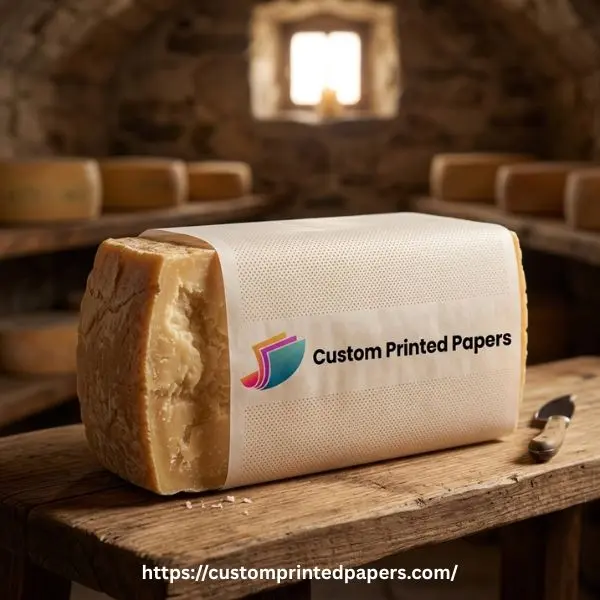
Aged cheese behaves differently from young cheese. It keeps respiring long after the cut. The longer it ages, the more gas it releases. A standard wrap traps that gas and turns the cheese sharp. Micro-perforation solves the problem that aging creates.
Why does aged cheese need micro-perforation?
Aged hard cheese releases ammonia and carbon dioxide as it matures. Trapped gas causes sharp off-flavors and surface mold. Micro-perforation vents that gas while holding humidity, so aged cheddar, parmesan, and gruyere age cleanly for three to six weeks.
Ammonia is the warning sign of trapped gas. A cheese that smells of ammonia has been suffocated by its wrap. Perforation gives the gas an exit, so the cheese keeps its true flavor instead of turning harsh at the rind.
Which cheeses suit micro-perforated cheese paper?
Micro-perforated paper suits aged and hard cheese. Parmesan, aged cheddar, gruyere, and pecorino respire heavily and benefit from extra gas release. The perforation matches their high respiration while the outer layer controls moisture and protects the rind.
Young soft cheese does not need this much venting. It releases less gas and dries faster. Micro-perforation suits the firm, long-aged cheeses that produce the most ammonia and carbon dioxide over weeks of storage.
| Cheese |
Age Profile |
Why Perforation Helps |
| Parmesan |
Long-aged hard |
High CO2 release |
| Aged cheddar |
Aged hard |
Strong ammonia release |
| Gruyere |
Aged Alpine |
Heavy respiration |
| Pecorino |
Aged hard |
Firm rind, high gas |
How do the micro-perforations work?
The perforations are tiny holes punched in the film layer. They open a controlled path for gas to escape. The holes are small enough to vent ammonia and carbon dioxide without letting the cheese dry out. The outer layer still holds the humidity the cheese needs.
Perforation size controls the balance. Holes that are too large dry the cheese. Holes that are too small trap gas. Custom Printed Papers sets the perforation pattern to match aged-cheese respiration, so the cheese vents gas and keeps moisture at once.
Does micro-perforation dry out the cheese?
No. Micro-perforation vents only excess gas. The outer wax or poly layer still holds humidity around the cheese. The result is a stable microclimate that releases ammonia and carbon dioxide while keeping the rind and paste from drying.
The fear with any vent is moisture loss. Micro-perforation avoids it by keeping the holes small and the outer barrier intact. The cheese loses gas, not water, so it ages cleanly without cracking or hardening at the surface.
Micro-perforated vs solid cheese paper?
Micro-perforated paper vents gas for aged hard cheese. Solid two-ply paper holds more moisture for younger cheese. Choose perforated for long-aged cheese that respires heavily. Choose solid for soft and semi-hard cheese that needs maximum humidity retention.
The two formats serve different ends of the aging curve. Perforated paper handles heavy gas. Solid paper handles moisture retention. For soft cheese, see wax-coated cheese paper.
What GSM is best for micro-perforated cheese paper?
Micro-perforated cheese paper runs 45 to 60 gsm. Standard 45 to 55 gsm stock suits aged wedges and counter cuts. Heavy 55 to 60 gsm stock suits hard wheels and long storage. Higher basis weight adds tear resistance around firm rinds.
| GSM |
Tier |
Best Use |
| 45–55 gsm |
Standard |
Aged wedges, counter cuts |
| 55–60 gsm |
Heavy |
Hard wheels, long storage |
Is micro-perforated cheese paper food-safe?
Yes. Micro-perforated cheese paper meets FDA 21 CFR 176.170 for direct food contact and prints with inks under FDA 21 CFR 175.300. Grease resistance stays PFAS-free. The perforation does not change the food-contact safety of the paper.
Every layer that touches the cheese meets food-contact clearance. The vent holes only manage gas. The paper stays safe for direct contact with aged cheese across its full storage window.
Can you print logos on micro-perforated cheese paper?
Yes. Custom Printed Papers prints micro-perforated cheese paper with food-safe inks, in CMYK or exact PMS Pantone. The print sits on the outer layer, away from the cheese. The perforation pattern works around your artwork so the logo stays clean.
Aged cheese is a premium product, and the wrap should signal that. Branded perforated paper marks your wheels and wedges as cared-for cheese. The print reads through the vent pattern without losing detail.
How to order micro-perforated cheese paper
Order in five steps:
1. Select your GSM, color, and size. 2. Upload artwork in PDF, AI, EPS, or PNG at 300 DPI minimum. 3. Approve a free digital proof within one business day. 4. Confirm color and placement. 5. Receive your run on a 50-unit MOQ with free shipping in 4 to 6 business days.
FAQ
What is micro-perforated cheese paper?
A two-ply cheese wrap with vent holes that release gas from aged hard cheese.
Does perforation dry out the cheese?
No. The outer layer holds humidity while perforation vents only excess gas.
Which cheeses need it?
Aged hard cheese like parmesan, aged cheddar, gruyere, and pecorino that respire heavily.
Is it food-safe?
Yes. It meets FDA 21 CFR 176.170 for direct food contact.
What is the MOQ and turnaround?
The minimum order is 50 units, printed and shipped in 4 to 6 business days.
Order micro-perforated cheese paper — MOQ 50, 4 to 6 business days, FDA-compliant, printed with your logo.