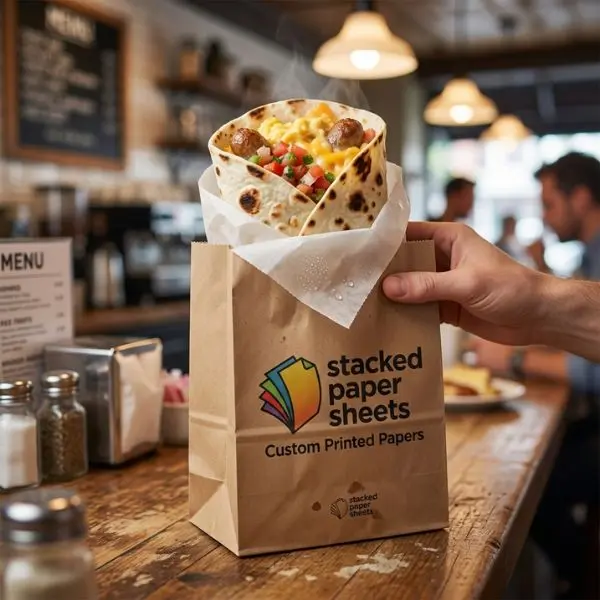
Why a food bag is a system, not just paper
Food-contact safety depends on the whole bag, not just the paper. The sheet, any coating, the inks, and the adhesives all have to be food-safe together. Inks and glues sit on the outer layers as a functional barrier so they do not migrate into food. A bag is only food-safe when every component is.
This is the part cheap food bags get wrong. A “kraft” bag printed with non-food-safe ink or glued with the wrong adhesive can let substances migrate into the food, even if the paper itself is fine. Food-grade construction keeps inks and adhesives on the outside, behind a functional barrier, and uses food-safe materials throughout. We build the full bag to food-contact standards, not just the paper layer.
The four grease barriers, and which to choose
Four coatings give grease resistance: PE is the cheapest, heat-sealable, and most common; wax gives strong oil resistance but limits recycling; PLA is plant-based and compostable; and water-based coating combines grease resistance with recyclability. Match the barrier to the food and your sustainability goal.
| Barrier |
Strength |
Trade-off |
| PE coating |
High, heat-sealable |
Cheap; harder to recycle |
| Wax |
Strong oil resistance |
Limited recyclability |
| PLA (plant-based) |
Good; compostable |
Needs industrial composting |
| Water-based |
Good; recyclable |
Newer, premium |
For dry baked goods, uncoated grease-resistant kraft is often enough. For fries and fried chicken, a stronger coating earns its place.
How is grease resistance actually measured?
Grease resistance is graded by Kit level, tested under TAPPI T 559. A higher Kit number means the paper blocks more aggressive oils. When a supplier says “grease-resistant,” ask for the Kit level and the test evidence for your food type, since the claim alone does not prove performance.
This is how you compare bags honestly. “Grease-resistant” with no number is marketing; a Kit level under a named test method is a spec. Fried, oily foods need a higher Kit rating than a dry pastry. Asking for the tested level, matched to your actual food, is how you avoid both a bag that leaks and one you overpaid for.
The hot-food problem most bags get wrong
Hot food creates two problems: steam and grease wicking. Enclosed steam condenses against the paper and softens the base and seams within minutes. A grease-soaked inner layer can wick oil back into the food. The fix is a vented or breathable build with a barrier that carries grease away, not one that holds it against the food.
Both failures are common and avoidable. A sealed bag holding hot fries traps steam that weakens the base just as the customer lifts it, and a liner that absorbs grease but holds it can re-soak the food through a wicking effect. The answer is a bag that lets steam escape and a barrier that blocks grease from the paper without trapping it against the food. We match the build to the food’s heat and oil load.
Breathable or sealed — keeping food crisp
Grease-resistant kraft has a quiet advantage for hot food: it breathes. A breathable grease-resistant bag lets steam and moisture escape so fried food stays crisp instead of steaming soft, while still blocking oil from the outside. A fully sealed coated bag keeps grease in but traps moisture, which suits some foods and ruins others. Match it to the menu: breathable for crisp fried food, sealed for items where moisture loss matters more than crispness.
Recyclable food bags — what’s realistic
Plain and water-based-coated kraft food bags recycle and compost; PE and wax coatings reduce recyclability in exchange for a stronger barrier. PLA composts industrially. The honest position is that the greasiest foods need the strongest barriers, which are the hardest to recycle, so there is a real trade-off between performance and end-of-life. For dry and lightly greasy food, an uncoated or water-based grade keeps both. Grease resistance comes from coatings and fibre, not fluorochemicals, so our bags are PFAS-free regardless of grade.
Frequently asked questions
Are kraft food bags food-safe? Yes. Food grades meet FDA 21 CFR 176.170, with food-safe inks and adhesives kept behind a functional barrier so they do not migrate into food.
Which coating is best for greasy food? PE for cost and a strong barrier, wax for heavy oil, water-based for grease resistance plus recyclability. Match it to the food.
Do food bags stop fried food going soggy? A breathable grease-resistant grade does, by venting steam while blocking oil. A fully sealed bag can trap moisture.
How do I know a bag is grease-resistant enough? Ask for the Kit level under TAPPI T 559, matched to your food type, not just the words “grease-resistant”.
Are they recyclable? Plain and water-based grades are; PE and wax trade recyclability for a stronger barrier. All are PFAS-free.
What is the MOQ and turnaround? Orders start at 50 units, printed and shipped in 4 to 6 business days.
Carry hot, greasy food without the leaks or the sog. Order custom kraft takeaway and food bags on a 50-unit minimum, with a free proof in one business day and free shipping in 4 to 6 business days. Tell us your food and we will spec the barrier.