How foil-backed chocolate paper is built
The material is a two-layer composite with a clear job for each layer. A thin aluminium foil, typically 6.5 to 12 micron, provides the barrier. A paper backing, around 25 to 40 gsm, adds body, stiffness, and a smooth print surface. The two are bonded by lamination. In the most common construction the printed graphics sit on the foil side and the food-grade paper faces the chocolate, so the surface touching your product is certified for direct contact and the branding stays on the outside.
That paper backing does more than carry ink. It gives the wrapper enough rigidity to handle cleanly on a packaging line and a more substantial feel in the customer’s hand. A bare foil creases and tears; a foil-paper laminate folds crisply around a rectangular bar and holds clean edges, which is exactly what bar wrapping needs.
Why laminated foil paper dominates chocolate bars
Laminated foil paper dominates bar wrapping because it folds crisply, holds its shape, and prints sharply. The paper backing gives the stiffness a flat bar needs for clean edges, the foil’s dead-fold keeps the wrap sealed, and the printable face carries branding. Plain foil alone lacks the body and print surface.
Different chocolate shapes call for different materials. Twist-wrapped coins and intricate moulded shapes often use plain foil for its dead-fold around curves. Flat bars almost always use foil-backed paper, because the rigid laminate wraps a rectangle neatly and presents a premium, branded face. For most bar makers, this is the default.
The lamination glue matters more than you think
Here is a point most suppliers never raise, and it separates a careful chocolate wrapper from a cheap one. The foil and paper are bonded with an adhesive, and the type of adhesive affects food safety. Much commodity foil paper uses wax-glue lamination, which has been linked to MOSH and MOAH migration, mineral-oil residues that can move into food. A food-grade, water-based or starch-based adhesive avoids that risk. For a chocolatier whose whole product is flavour purity, the glue inside the laminate is not a detail to ignore. We can specify a food-safe lamination that protects the chocolate’s taste, not just its appearance.
Foil-backed paper or plain foil — which do you need?
Choose foil-backed paper for flat bars and branded wrapping that needs stiffness and a print surface. Choose plain foil for twist-wraps, coins, and intricate shapes that need maximum dead-fold around curves. Bars favour the laminate; hand-twisted and moulded pieces often favour bare foil.
The decision follows the chocolate’s shape and how it is wrapped. A machine-wrapped or hand-folded bar wants the crisp, rigid fold of foil-backed paper. A truffle twisted shut wants the soft conformability of plain foil. Many brands run both. For the metallic gift look, see gold and silver foil wrappers; for hand-wrapped pieces, see truffle and bonbon wrappers.
Printing, embossing, and foil-stamping the face
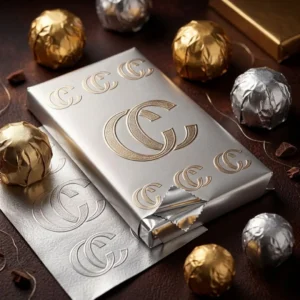
The paper or foil face takes branding several ways. Flat printing in CMYK or Pantone lays down colour and logos with food-safe inks. Embossing raises the logo for a tactile, three-dimensional mark that catches light. Debossing presses it in for a subtle, refined finish. Foil-stamping adds a metallic highlight over print. Because the branding sits on the outer face, none of it touches the chocolate, so a bar can look richly decorated and still meet food-contact rules on the inside.
Frequently asked questions
Is foil-backed chocolate paper food-safe?
Yes. The food-contact face is certified food-grade and meets FDA 21 CFR 176.170. A food-safe lamination adhesive protects against MOSH/MOAH migration.
Which side touches the chocolate?
The paper face contacts the chocolate and the printed foil face stays outward, in the standard construction.
Can it be embossed and foil-stamped?
Yes. The face takes printing, embossing, debossing, and foil-stamping for a premium finish.
Is it recyclable?
Foil-paper laminate recycles poorly because the layers bond tightly. Water-based glue versions can be separated for recycling; glassine and compostable grades are greener alternatives.
What thickness should I order?
Foil runs 6.5 to 12 micron and backing 25 to 40 gsm. Heavier specs suit premium bars that must hold a firm shape.
What is the MOQ and turnaround?
Orders start at 50 units, printed and shipped in 4 to 6 business days.
Wrap your bars in the full triple barrier, with your brand on the outside. Order custom foil-backed chocolate paper on a 50-unit minimum, with a free proof in one business day and free shipping in 4 to 6 business days. Send your artwork and we will spec a food-safe laminate.