
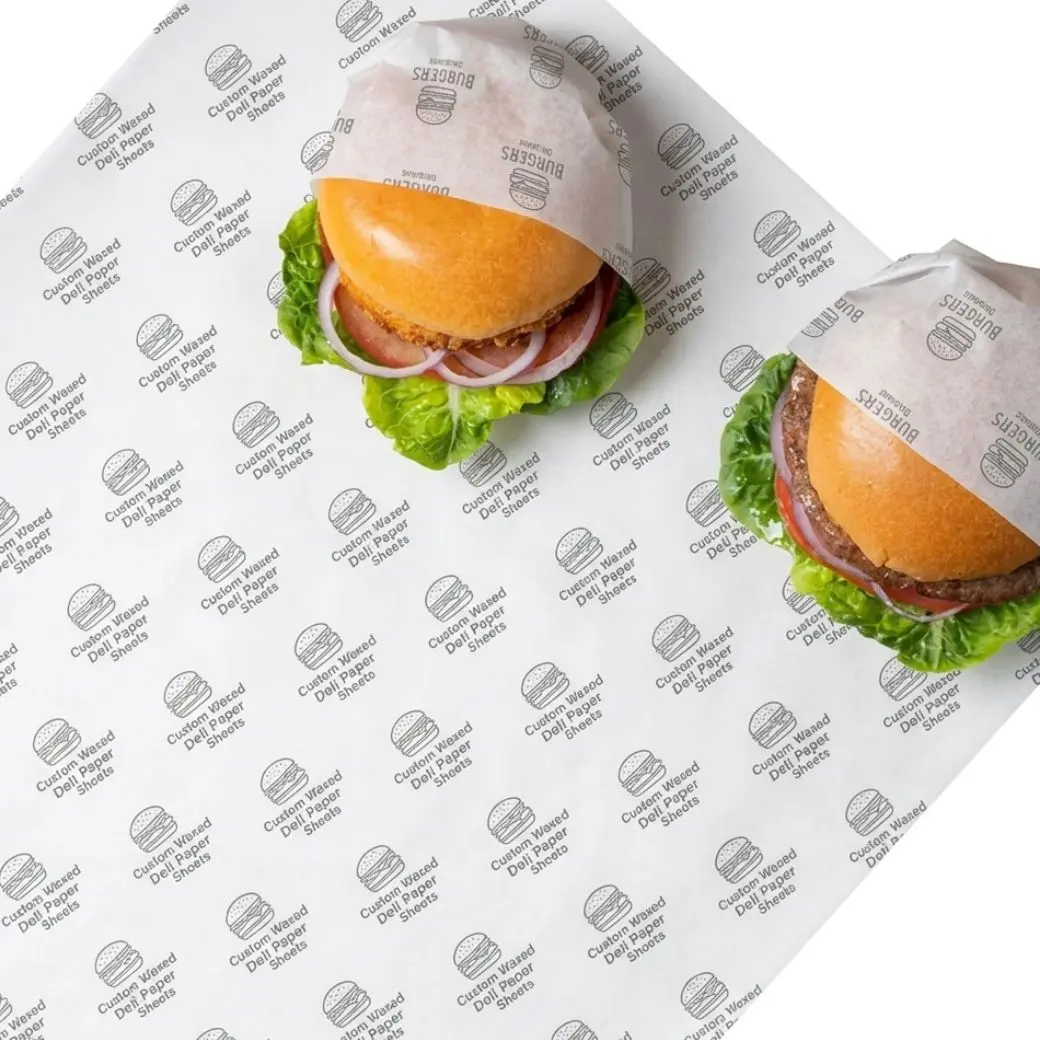
If you run a deli, sandwich shop or food truck and you are ordering paper for the first time or switching suppliers. This guide covers everything you need to know before you buy.
What Deli Paper Actually Is
Deli paper is food-grade paper designed for direct contact with food. It wraps sandwiches, lines baskets and trays, separates deli cuts and covers surfaces at food service counters. The defining characteristic is that it is safe for direct food contact it is manufactured to meet FDA standards for the food that touches it, whether that is a dry turkey club, a sauced meatball sub or a greasy pile of fries.
That sounds straightforward, but the term deli paper covers a wider range of materials than most people buying it for the first time realize. White deli paper and brown deli paper are made from different types of kraft pulp. Waxed deli paper has a coating on the food side that standard deli paper does not. Each one behaves differently at a counter, holds up differently under different fillings and suits different types of food businesses.
The paper itself is not what you are buying when you order custom deli paper. You are buying a surface that carries your brand at the moment a customer picks up their food. That moment is the last brand touchpoint before they eat and in most food service settings, it is the first thing in frame when they photograph the order.
The Four Types of Deli Paper
Most suppliers list deli paper as one product. In practice, there are four distinct types in common use at food service counters. Each has a specific application and a specific buyer.
Custom White Deli Paper
Made from bleached kraft pulp. The bleaching process gives the paper a clean, uniform white surface that holds colour print consistently across the full sheet. Full-colour logos print sharply on white deli paper because the bleached surface gives ink a consistent base without the natural fibre variation you see in unbleached kraft.
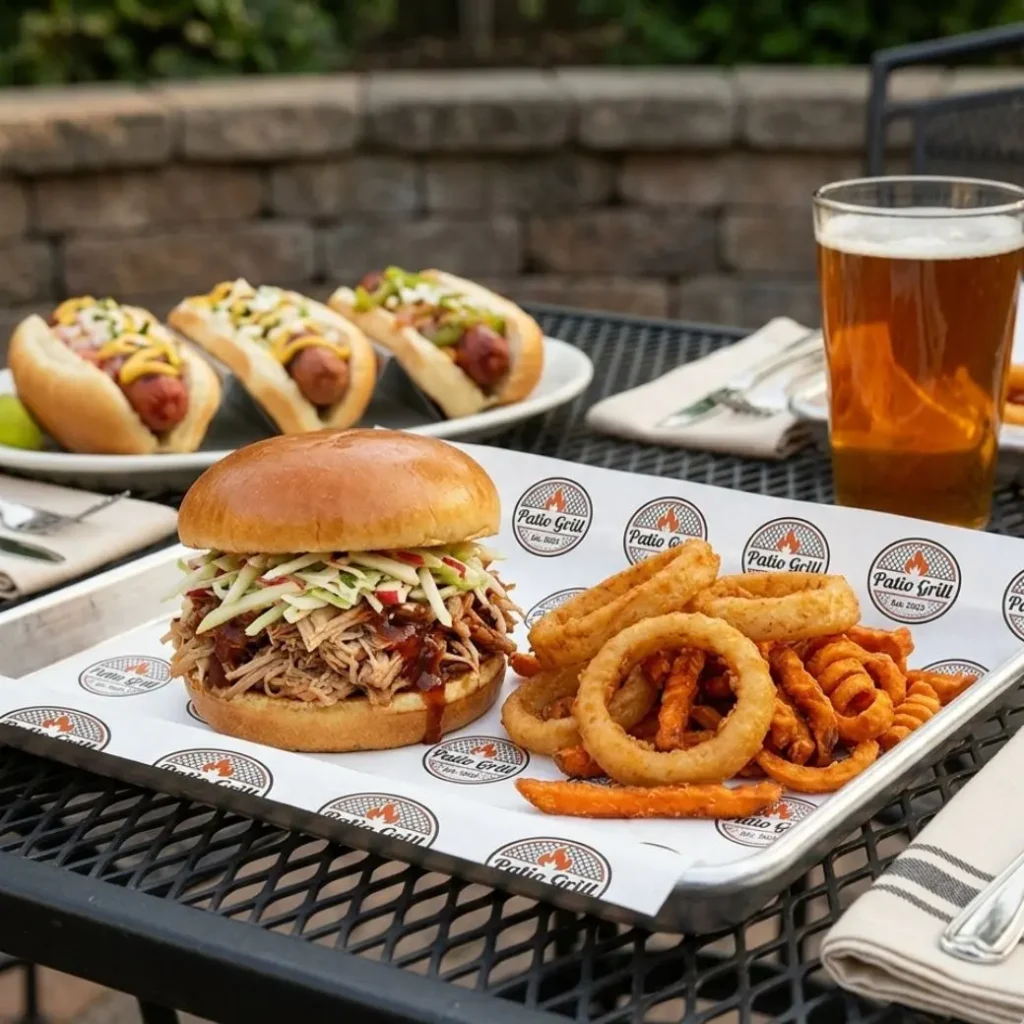
White deli paper is the default at most sandwich shops, fast casual restaurants and deli counters. It reads as professional and clean at the point of handoff. Most buyers start here and have no reason to move to a different material unless the brand identity specifically calls for it.
Brown Kraft Deli Paper
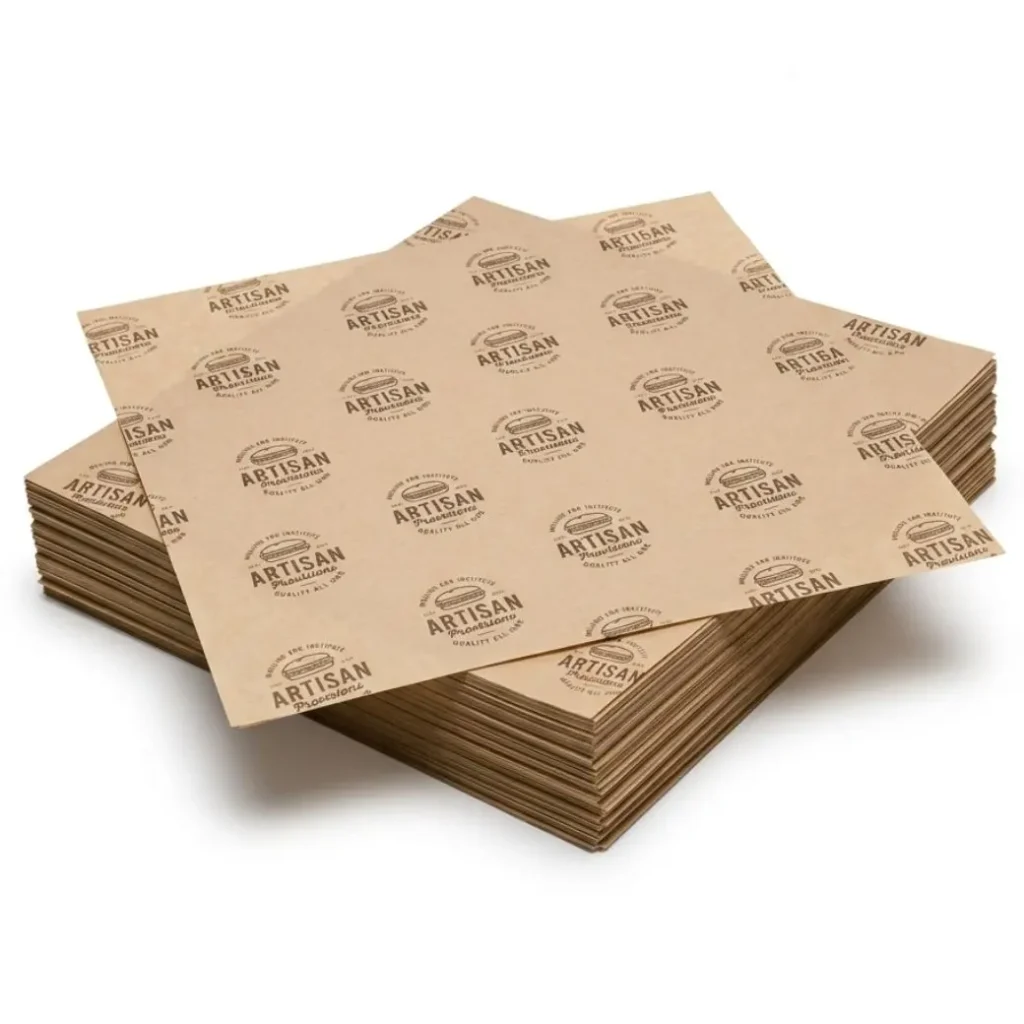
Made from unbleached kraft pulp no bleaching agents, no chlorine compounds, no optical brighteners. The natural brown colour is what kraft paper looks like when nothing is added to it. The surface has slight natural fibre variations that affect highly detailed multi-colour print but handle 1-color and 2-color logo print cleanly.
Brown kraft deli paper suits artisan delis, farmers market vendors, butcher counters and any food business where the natural, unprocessed aesthetic is part of the brand. It is fully recyclable and compostable. For eco-certified businesses with sustainability requirements in their supplier agreements, unbleached kraft ticks boxes that bleached white does not.
Waxed Deli Paper
Standard deli paper white or brown has no coating on the food contact surface. Moisture from wet fillings absorbs into the paper fibre over time, which softens the sheet and eventually pushes grease through to the outer surface. For a dry sandwich, that is not a problem. For a meatball sub or a marinated chicken wrap, it is.
Waxed deli paper has a paraffin or soy wax coating on the food contact side. The coating creates a moisture barrier wet fillings sit on top of the wax rather than absorbing into the paper. The sheet holds its structure. The outer surface, where your logo is printed, stays dry and intact. The wrap looks the same when the customer opens it as it did when your team sent it out.
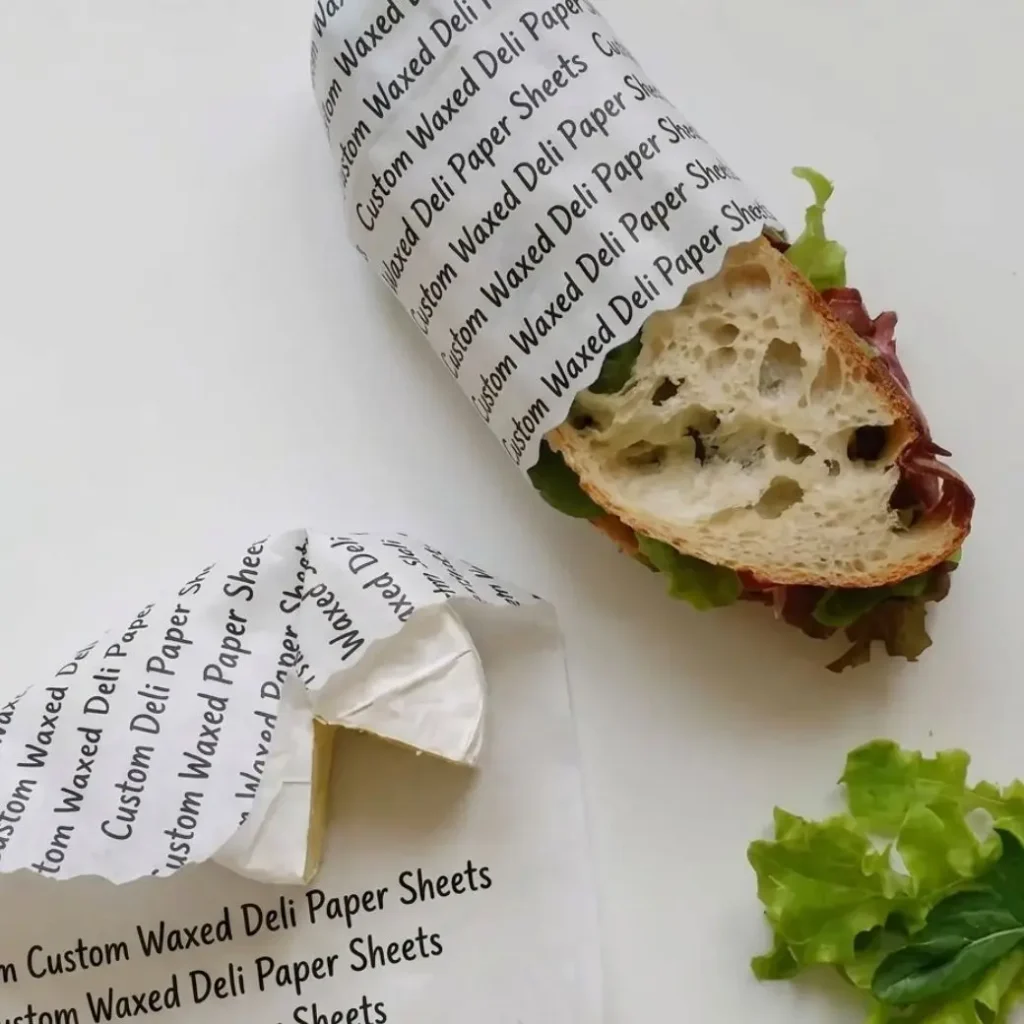
Waxed deli paper is slightly stiffer and heavier than uncoated sheets. At a high-speed counter doing hundreds of wraps per hour, some operators find it marginally slower to fold. At a counter where the quality of the wrap matters as much as the speed, waxed paper is the correct specification.
Custom Deli Paper Rolls
White and brown kraft deli paper are both available in roll format as well as pre-cut sheets. The material is identical the difference is in how it arrives and how it is used at the counter. Rolls mount on dispenser holders and allow the team member to pull and tear to length in one motion. Sheets require a separate pull-from-stack step.
For counters doing consistent high volume during a defined peak period, rolls reduce handling time per wrap. For lower-volume operations or setups without dispenser space, pre-cut sheets are easier to manage. The choice is operational, not material.

White, Brown or Waxed – Side by Side
If you are still deciding which type fits your operation, this comparison covers the key differences at a glance.
A few things the table does not capture: waxed deli paper is not oven safe. The wax coating melts above 200 degrees Fahrenheit. If you need paper for any heat application, parchment paper with a silicone coating is the correct product. Deli paper waxed or uncoated is for wrapping and serving at ambient and room temperature conditions.
What GSM Means for Deli Paper
GSM stands for grams per square metre. It is the standard measure of paper weight in the industry. A higher GSM means a heavier, thicker sheet. For customized deli paper buyers, GSM affects three things: how the paper feels in the hand, how it holds under the weight of the filling and how it folds at speed.
- 25 to 30 GSM is the light end. Suitable for dry items cold cuts, pastries, small bakery items. Thin and flexible. Folds easily at speed. Not suitable for wet or heavily filled sandwiches.
- 35 to 40 GSM is the working standard at most deli counters. Heavy enough to hold a standard sandwich without tearing or softening under light grease. Flexible enough to fold cleanly with one hand at high speed. This is where most buyers land.
- 42 to 50 GSM is the heavy end. Better resistance under heavier, wetter fillings. Slightly stiffer fold. Used in operations where the filling consistently puts the paper under pressure – heavily loaded subs, marinated items, anything that sits wrapped for more than a few minutes before the customer picks it up.
GSM is not a measure of grease resistance. A 50 GSM uncoated deli sheet does not resist grease better than a 35 GSM uncoated sheet. It is heavier and holds more structural integrity under load, but grease still absorbs through an uncoated surface over time. If grease resistance is the concern, waxed deli paper addresses it not a higher GSM uncoated sheet.
Is Deli Paper Food Safe
Yes, but the compliance standard matters more than the claim. FDA 21 CFR 176.170 is the specific regulation that governs paper and paperboard in direct contact with aqueous and fatty foods in the United States. That is the standard that covers deli paper used with sandwiches, deli meats, sauces and similar food service applications. A supplier who prints food safe on their product page is making a claim. A supplier who cites FDA 21 CFR 176.170 and provides compliance documentation with every order is meeting a standard.
The difference matters when a health inspector visits. It also matters when you supply to a retailer, distributor or food service chain that asks for packaging documentation as part of their supplier approval process. Ask your supplier for compliance documentation before you place a production order not after.
The inks on printed deli paper also matter. The printed surface is typically the outer face of the sheet, away from the food. But ink formulation still falls under food contact material standards. Food-safe water-based inks with no heavy metals and no VOCs are the correct specification for printed deli paper. Ask about ink safety if it is not stated upfront.
How to Choose the Right Deli Paper for Your Business
The decision comes down to three questions in order.
First: what are you wrapping and how wet is it?
Dry fillings – cold cuts, cheese, bread, pastries: uncoated white or brown kraft at 35 to 40 GSM.
Wet fillings – sauced sandwiches, marinated items, anything that sits wrapped for more than a few minutes: waxed deli paper, paraffin or soy wax depending on your sustainability requirements.
Second: what does your brand look like?
- Clean, professional presentation with full-colour branding: white bleached kraft.
- Natural, artisan or eco-first identity: brown unbleached kraft.
Third: how does your counter operate?
- High-volume counter with a defined peak period and a dispenser mount: rolls.
- Lower-volume counter, food truck or setup without dispenser space: pre-cut sheets.
If you are ordering custom deli paper for the first time, request a sample of the type you think you need before placing a production order. The difference between 35 GSM and 42 GSM is not visible on a specification sheet. It is something you feel when you fold the paper at your counter at speed during a busy service.
Custom Deli Paper at Wholesale – Where to Order
We manufacture all four types of deli paper covered in this guide: white sheets, brown kraft sheets, waxed sheets and rolls with custom logo printing on every order. Minimum orders start at 50 sheets. All materials are FDA 21 CFR 176.170 compliant with documentation on every order.
Frequently Asked Questions
What is the difference between deli paper and parchment paper
Deli paper is designed for wrapping and serving foods at counter and ambient temperatures. Parchment paper has a silicone coating that makes it non-stick and oven safe to 450 degrees Fahrenheit when it is designed for baking. The two are not interchangeable. Putting deli paper in an oven causes the paper to degrade and stick to the food. Using parchment paper to wrap a sandwich means paying for a silicone coating your counter does not need.
Can deli paper go in the microwave?
Uncoated white and brown kraft deli paper can go in the microwave for short periods under normal food reheating conditions. Waxed deli paper should not go in the microwave – the wax coating is not rated for microwave heat. If your customers regularly reheat food in the wrapper, uncoated kraft is the correct specification.
What is the minimum order for custom printed deli paper?
Minimum order is 50 sheets across all types. Wholesale pricing starts at 2,000 sheets. For first-time buyers, we recommend requesting a free sample pack of whichever type you are considering before placing a production run – the weight and surface quality of the paper is something you need to handle at your counter, not judge from a specification sheet.
Does the logo print on both sides of the deli paper?
No. Custom deli paper is printed on the outer surface only the surface that faces away from the food. The food contact side carries no ink. This is the correct configuration for food contact compliance and is standard across all custom deli paper manufacturing.