
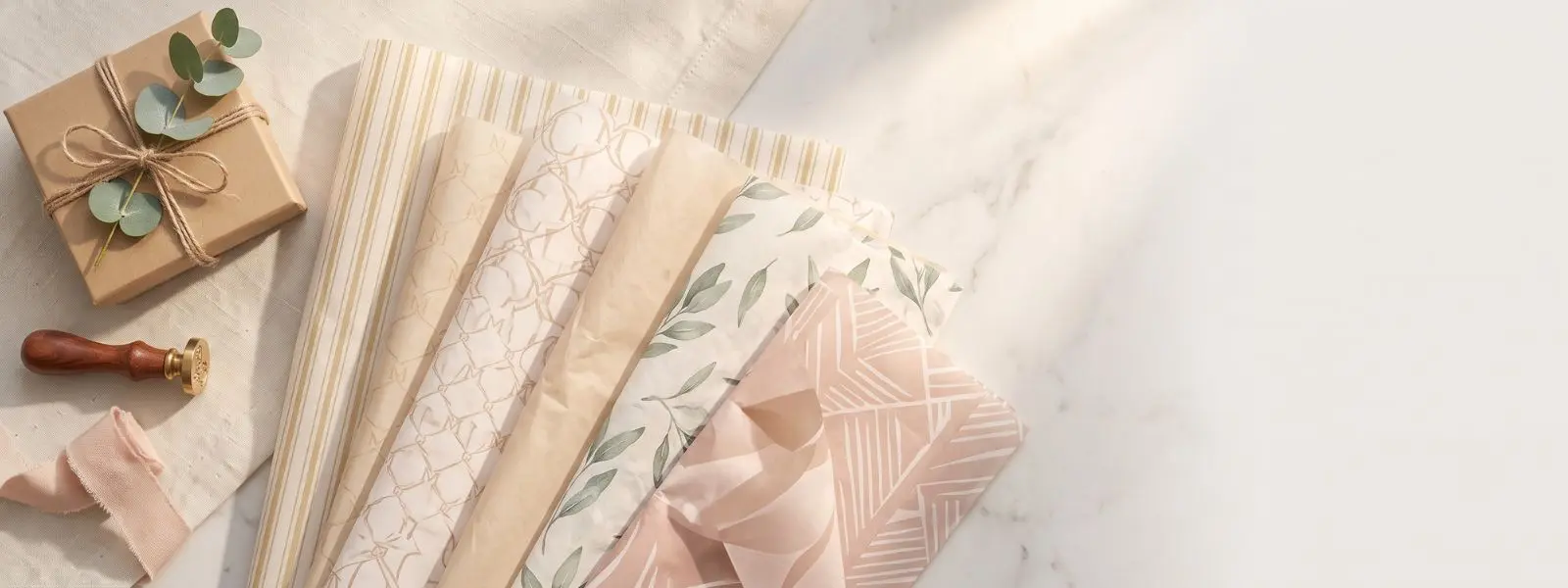
Custom tissue paper is one of the highest-impact, lowest-cost branding tools a business has. It is the soft sheet a customer touches first when they open a box — the pause before the product, the moment that decides whether packaging feels premium or generic. Done well, it protects the product, elevates the unboxing experience, and puts your brand in the customer’s hands on every order. Done as an afterthought, it is a missed opportunity wrapped around a good product.
Custom tissue paper is thin, lightweight packaging tissue printed with a brand’s logo, colours, or pattern, used to wrap, cushion, and present products so the unboxing experience reinforces the brand. It combines protection and presentation in a single, inexpensive layer.
Beyond looking good, tissue paper earns its place technically: its low basis weight and gently creped texture let it wrap and cushion delicate items without adding shipping weight or bulk. Businesses across retail, e-commerce, apparel, gourmet food, and gifting use it because branded packaging measurably raises perceived value and because a large majority of shoppers now prefer thoughtful, eco-friendly packaging. This guide covers what custom tissue paper is used for, the weights and types to choose, printing options, sizes, sustainability, and how to order it.
What Is Custom Tissue Paper Used For?
Custom tissue paper is used to wrap products, cushion fragile items, line boxes and bags, and elevate the unboxing experience with branding. Its versatility is why it spans so many industries.
- Unboxing experience — wrapping the product so the first thing a customer sees is your brand, not bare packaging.
- Product protection — a soft layer that guards against scuffs, dust, and minor impact in transit.
- Cushioning and void fill — crumpled tissue protects delicate items without heavy or plastic fillers.
- Gift and retail wrap — lining gift boxes and shopping bags for a finished, premium look.
- Product separation — interleaving items so surfaces do not rub or transfer.
The businesses that rely on it most are retail stores, e-commerce and subscription brands, apparel and boutique sellers, gourmet food companies, gift shops, and specialty makers. In each case the logic is the same: tissue paper is the cheapest surface that reaches every single customer, so branding it turns a functional wrap into a repeatable brand impression. Pairing tissue with matching boxes or bags — same colour or repeating pattern — compounds the effect and builds anticipation before the product is even revealed.
What Is Tissue Paper, and How Is It Made?
Tissue paper is a very thin, lightweight paper made from wood pulp or recycled fibres, distinguished by its low basis weight, softness, and lightly crinkled texture. That texture is not an accident — it comes from how the paper is manufactured.
Tissue is produced on a specialised machine fitted with a large heated drum called a Yankee cylinder. The wet paper adheres to the cylinder, dries, and is then scraped off by a blade in a process called creping, which micro-folds the sheet to create tissue’s characteristic softness, flexibility, and gentle crinkle. This is what separates tissue from standard packaging paper: it is thin and smooth enough to drape and wrap, yet strong enough to protect. Understanding this helps explain the trade-offs in weight and durability that follow.
What Types and Weights of Tissue Paper Should a Business Choose?
Businesses should choose tissue weight by whether the priority is delicate presentation or protective cushioning, and choose colour and grade by brand look and what the tissue will touch. Weight, colour, and finish are the three levers.
On weight, tissue paper is commonly offered in three GSM tiers:
| Weight tier | Approx. GSM | Best for |
|---|---|---|
| Lightweight | 17–20 gsm | Delicate wrapping, elegant presentation, gift lining |
| Standard | 21–28 gsm | Everyday product wrap, the versatile default |
| Premium / heavy | 30–40 gsm | Durable wrap, cushioning, a substantial feel |
Lighter tissue drapes beautifully and highlights print, while heavier tissue offers more protection and a more premium hand-feel. On colour, the core choices are white (crisp, high-contrast for print), natural kraft (rustic, eco), and solid colours matched to brand palette. One specification matters more than most buyers realise: acid-free and sulfur-free tissue. Acids and sulfur in ordinary tissue can, over time, tarnish metals and discolour or degrade delicate materials — so for apparel, jewellery, silverware, and anything stored in the wrap, acid-free, sulfur-free tissue protects the product as well as presents it.
What Printing Options Are Available for Custom Tissue Paper?
Custom tissue paper can be printed several ways, from a single-colour logo to a full-coverage repeating pattern, and the method you choose shapes both look and cost. Matching the print style to your design intent is where many brands get better results for less money.
The main printing approaches are:
- Spot / solid printing — a single ink colour, ideal for a clean one-colour logo or simple mark; the most cost-effective option.
- Scatter / repeat printing — the logo or motif repeated across the whole sheet, giving an all-over branded look.
- Edge-to-edge / flood — heavier coverage or a full background colour for a bold, saturated effect.
- Full-colour digital — multi-colour artwork, gradients, and detailed designs for complex brand graphics.
Finishes add another layer: matte inks read understated and premium, while metallic inks (gold, silver, copper) create a luxe accent for gifting and high-end retail. A practical tip that competitors rarely give: a subtle, low-coverage print — a small repeated logo rather than a saturated flood — usually looks more premium, costs less, and keeps the tissue easier to recycle. Let the design breathe rather than covering every inch.
What Sizes Does Custom Tissue Paper Come In?
Custom tissue paper comes in a range of standard sheet sizes, and the right one is set by the product and the box or bag it lines. Common sizes include 15″ × 20″, 18″ × 24″, 20″ × 30″, and 14″ × 20″, with larger formats often supplied half-folded.
Sizing logic is simple: the sheet should comfortably wrap the product with enough overlap to fold cleanly, or fully line the box or bag with a slight overhang for a finished look. As a rule, choose a size that extends a few inches beyond the product on all sides for wrapping, and one that matches or slightly exceeds the box footprint for lining. Oversized tissue can be trimmed or folded, but tissue that is too small forces awkward, unbranded joins. When in doubt, size to your most common product or your standard shipping box, and confirm dimensions with your supplier against your packaging.
Is Custom Tissue Paper Eco-Friendly and Recyclable?
Yes — custom tissue paper can be a genuinely sustainable packaging choice when it uses recycled fibre, eco-friendly inks, and light print coverage, and it replaces plastic void fill. Sustainability here is a series of specific choices, not a single label.
Start with the paper: recycled and 100% post-consumer options are widely available and are curbside recyclable, and tissue itself is biodegradable. Next, the ink: water-based, soy-based, or algae-based inks keep the sheet recyclable and avoid the concerns of heavier solvent inks, and low print coverage further protects recyclability at end of life. Acid-free, sulfur-free stock adds an archival, product-safe dimension. Finally, the substitution effect: crumpled tissue replaces plastic bubble wrap and air pillows, cutting plastic out of the box entirely. For a food business, food-safe inks make branded tissue suitable for gourmet, bakery, and confectionery wrapping without compromising contact safety. Choosing recycled paper, eco inks, and restrained coverage gives you presentation and a defensible sustainability story at once.
How to Order Custom Tissue Paper for Your Business
Ordering custom tissue paper follows a simple path: choose the specs, submit artwork, approve a proof, then produce. Knowing the steps upfront avoids surprises on minimums and timelines.
Lock these decisions in order: weight (GSM), colour and grade (including acid-free if needed), print method (spot, scatter, or full-colour), size, and ink type (standard or eco/food-safe). Then prepare artwork — a vector logo is best for crisp printing — and expect the supplier to return a digital proof for written approval before production begins. Two practical notes: minimum order quantities start at just 50 sheets at Custom Printed Papers and scale from there, and production typically runs about one to two weeks plus proofing, so plan ahead of peak seasons. For a cohesive result, order tissue alongside matching boxes or bags so the whole package reads as one brand.
Explore custom tissue paper and printed tissue paper to start, and pair it with custom wrapping paper or custom paper bags for a complete unboxing system.