
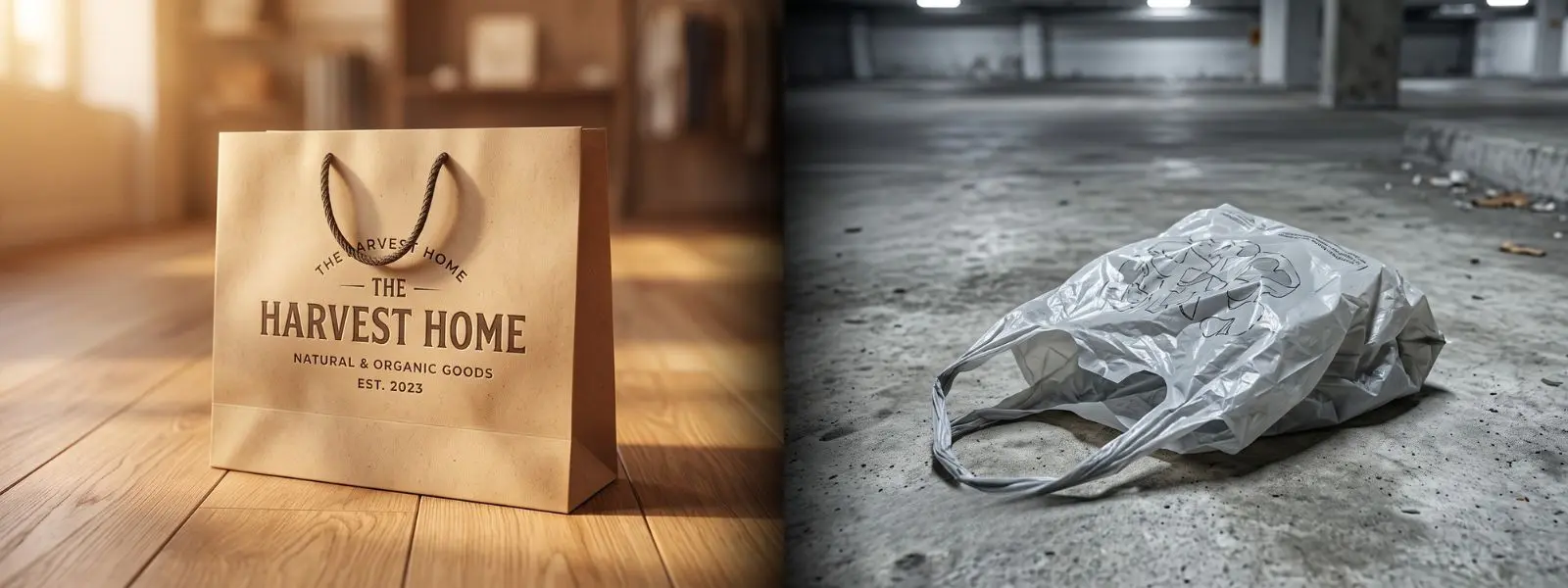
For decades plastic was the default retail bag cheap, water-resistant, and everywhere. That default is now collapsing. Plastic bags are banned at checkout in a growing list of states, shoppers increasingly judge brands by their packaging, and a plain plastic bag does nothing for a brand once it leaves the store. For most retailers in 2026, the practical question is no longer whether to switch, but how to make the switch work.
For retail, custom kraft paper bags win over plastic on three fronts that matter most: regulatory compliance as plastic bag bans spread, brand value from a printable marketing surface, and recyclability — even though plastic still holds edges in cost, water resistance, and raw durability. The branding advantage is the one plastic cannot match.
The decisive point is that a branded paper bag doubles as marketing, while a plastic bag heads to landfill. Add the regulatory reality — as of early 2026, single-use plastic bags are banned at grocery and retail checkout in 12 states — with more moving that way — and paper becomes both the compliant and the smarter branding choice. This guide compares the two honestly on regulation, environment, branding, and customer preference, and notes where plastic still makes sense. For bag specs, see the custom paper bags for retail guide.
Are Plastic Bags Being Banned?
Yes — single-use plastic carryout bags are banned or restricted in a growing number of U.S. states, making paper the default compliant choice at checkout. This is the most immediate reason retailers are switching.
As of early 2026, plastic bags are banned at grocery and retail checkout in 12 states — California, Colorado, Connecticut, Delaware, Hawaii, Maine, New Jersey, New York, Oregon, Rhode Island, Vermont, and Washington — with Massachusetts implementing its own ban and many cities adding local rules. California’s SB 1053, effective January 1, 2026, closed the loophole that had let stores hand out thick “reusable” plastic bags, so stores may now offer only paper bags at checkout, with recycled-content requirements rising over time. Many states also charge a small paper-bag fee (commonly 5–12 cents) and require minimum post-consumer recycled content. A few states preempt local bans, and some restrict paper too, so the exact rules vary by location. For retailers operating in banned states, plastic is simply no longer an option — and switching proactively avoids fines and last-minute scrambles.
Paper vs Plastic Bags: Which Is Better for the Environment?
Paper bags are the better environmental choice overall, but the honest answer includes a trade-off: paper biodegrades and recycles far better, while plastic has a lower upfront production footprint. The full lifecycle, not a single stat, tells the story.
The case for paper is strong on end-of-life. Paper bags are made from renewable wood fiber, biodegrade in weeks, and are widely recyclable, whereas plastic is made from fossil fuels, persists for 450 years or more, and breaks down into microplastics that pollute waterways and the food chain. The honest counterpoint is production: making a virgin paper bag uses more water and energy and emits more CO2 upfront than a thin plastic bag — a fact fewer than two-thirds of consumers realize. What tips the balance decisively toward paper is sourcing and behavior: a bag made from recycled fiber, certified sustainable (FSC), and either recycled or reused at end of life clears plastic comprehensively. In other words, paper wins the lifecycle when it is recycled-content and reused — which is exactly how retailers should spec it. For the fiber choice behind that, see virgin vs recycled kraft paper.
| Factor | Kraft paper bag | Plastic bag |
|---|---|---|
| Material | Renewable wood fiber | Fossil-fuel plastic |
| Biodegrades | In weeks | 450+ years |
| Recyclable | Widely, curbside | Rarely, in practice |
| Upfront CO2 | Higher (virgin) | Lower |
| Best-case footprint | Recycled + reused | Poor regardless |
| Branding surface | Excellent print | Limited, cheap look |
| Compliance (banned states) | Allowed | Prohibited |
Why Do Custom Paper Bags Win for Retail Branding?
Custom paper bags win on branding because paper is a printable marketing surface that carries your logo out of the store, while a plastic bag adds nothing to the brand and lands in the trash. This is the advantage that holds even setting the eco debate aside.
A branded kraft bag is effectively a walking billboard: it prints logos, brand colors, and full designs cleanly, giving every purchase a professional, premium presentation that reinforces the brand at the counter and on the street. Paper also feels more substantial in the hand, supporting the kind of unboxing and carry experience that shoppers associate with quality and increasingly share online. Plastic, by contrast, prints poorly, reads cheap, and communicates nothing about a brand’s values. And because sustainable packaging now signals that a business cares — a signal eco-conscious shoppers reward with loyalty — a custom paper bag aligns the brand with rising customer expectations. The result is that the same bag doing the physical job of carrying goods also does marketing and brand-building work plastic simply cannot.
Do Customers Prefer Paper or Plastic Bags?
Customer preference is mixed: surveys show many shoppers still find plastic more convenient, yet support for plastic bans is widespread and expectations for sustainable packaging are rising. For retailers, the trend matters more than the current split.
It would be inaccurate to claim shoppers uniformly prefer paper — polling shows plastic still wins on pure convenience for a meaningful share of consumers, and paper bags draw complaints when they are flimsy or fee-charged. But the same public only narrowly opposes plastic bans, and a growing majority expects brands to offer sustainable packaging and rewards those that do. The practical takeaway is that sentiment and regulation are both moving toward paper, so a retailer switching now aligns with where customers are heading, not just where they are. The way to win the convenience argument is to spec paper properly — right GSM, right handle — so the bag feels sturdy and premium rather than flimsy, removing the main reason shoppers miss plastic.
When Do Plastic Bags Still Make Sense?
Plastic still has genuine edges in a few situations — wet or greasy items, very heavy loads, and the lowest unit cost — but proper paper handles the vast majority of retail. Honesty here builds trust and points to the right spec.
Plastic’s real advantages are water resistance (useful for wet produce, ice, or drippy items), raw tensile strength for very heavy or sharp loads, and a lower per-unit price. Where those factors are critical and no ban applies, plastic or a coated alternative may still fit. For nearly all standard retail, though — apparel, gifts, groceries, boutique goods, takeout — a correctly specified paper bag with the right weight and handle carries the load reliably. The fix for paper’s weaknesses is specification, not switching back: heavier GSM for weight, reinforced or rope handles for load, and a moisture-resistant liner or coating where wet items demand it. Choose the paper spec to match the job and plastic’s remaining edge shrinks to a narrow set of cases.
For the right build, explore custom paper bags and white kraft paper bags, and match weight and handle in the retail paper bags guide.