
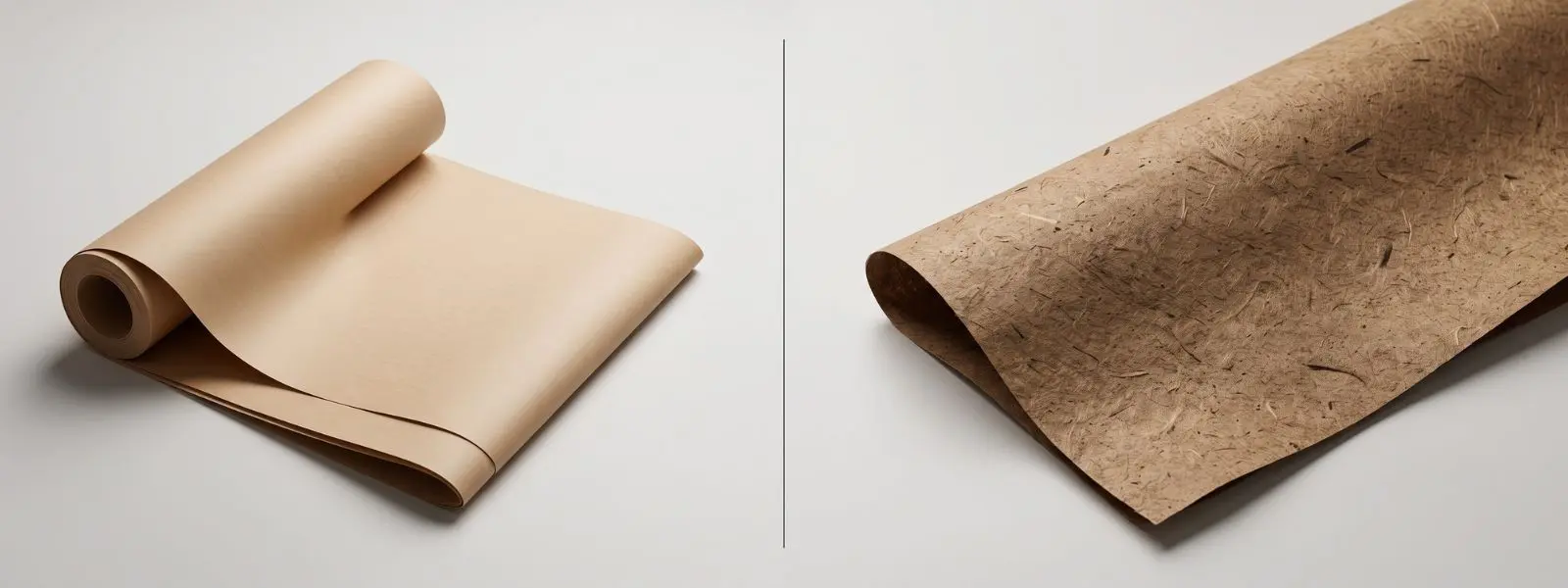
Choosing between virgin and recycled kraft paper is one of the most consequential packaging decisions a brand makes. Both are kraft paper — strong, printable, and recyclable — but they diverge sharply on strength, cost, appearance, and sustainability messaging. The wrong choice either overpays for strength you do not need or fails under a load you do.
Choose virgin kraft when strength, consistency, or direct food contact matter most; choose recycled kraft when sustainability messaging, cost, and lighter-duty use are the priority. For most brands, that single distinction settles the decision.
The trade-off is rooted in the fibre. Virgin kraft comes from fresh wood pulp with long, intact cellulose fibres that deliver higher tensile, burst, and tear strength and a uniform surface. Recycled kraft reuses post-consumer fibre, which is shorter and weaker but diverts waste and typically costs less. This guide breaks down the real differences in strength, sustainability, cost, and food safety, then gives you a decision framework to match the right kraft to your brand. For the material basics, see what is kraft paper.
Virgin vs Recycled Kraft Paper: What’s the Difference?
The core difference is fibre source and length: virgin kraft uses long fibres from fresh wood pulp, while recycled kraft uses shorter fibres recovered from used paper. Everything else follows from that.
Virgin kraft is produced from fresh softwood pulp via the kraft (sulfate) process, which preserves long cellulose fibres — and long fibres bond into stronger paper. Recycled kraft is made from post-consumer or post-industrial waste, where fibres have already been through the papermaking cycle at least once and have shortened as a result. That single structural difference cascades into every practical comparison: strength, appearance, consistency, cost, and end-of-life. It is worth noting that many recycled grades blend in a portion of virgin fibre to hit minimum performance specs, so “recycled” often means “mostly recycled” rather than 100%.
Which Is Stronger — Virgin or Recycled Kraft Paper?
Virgin kraft paper is stronger than recycled, with higher tensile, burst, and tear strength and more consistent performance across batches. For load-bearing packaging, this is the deciding factor.
The reason is fibre length. Long virgin fibres form strong bonds, letting even lower-GSM virgin kraft support surprisingly heavy loads. Recycled fibres are shorter and weaker, and they shorten further with every recycling pass — after several cycles, cellulose fibres become too short to bond strongly, which is why most recycled kraft blends in virgin fibre. Recycled grades also vary more from batch to batch, since the recovered-fibre stream is less uniform than fresh pulp. For heavy grocery bags, export cartons, industrial sacks, or any application where a bag failure is costly, virgin kraft’s predictable strength wins. For lighter retail bags, gift wrap, void fill, and secondary packaging, recycled kraft is more than strong enough.
Which Is More Sustainable and Cost-Effective?
Recycled kraft is both cheaper and carries a stronger sustainability message, typically costing less than virgin while diverting waste from landfill. Virgin kraft, though renewable, has a higher raw-material and environmental cost.
On cost, recycled kraft is commonly cited as running several percentage points to around 15% below comparable virgin grades, because it uses recovered fibre rather than fresh pulp. On sustainability, recycled kraft avoids harvesting new timber and reduces landfill waste, and its visible flecked fibres act as a built-in proof point that resonates with eco-conscious buyers more than a printed claim. Regulatory pressure is accelerating this shift, with extended producer responsibility (EPR) rules in several markets pushing brands toward recycled content, and many consumers willing to pay a premium for demonstrably sustainable packaging.
That said, virgin kraft is not “unsustainable” — it is made from a renewable resource and is fully recyclable and biodegradable. The key compliance signal for either type is responsible sourcing evidence such as FSC or PEFC certification, which matters more than the virgin-versus-recycled label itself. If your sustainability positioning is central, recycled or FSC-certified stock is the stronger story; if it is important but secondary, either kraft already beats plastic.
Which Kraft Paper Is Better for Food Packaging?
For direct food contact, virgin food-grade kraft is the safer choice, because recycled fibre can carry mineral oils and contaminants from its previous printed life. This is the most important nuance for any food brand, and it is easy to miss.
Recycled paper is recovered from printed matter, so it can retain traces of mineral oils, inks, and other substances that are unacceptable against food. For that reason, virgin food-grade kraft — the same fibre behind butcher and deli papers — is preferred wherever the paper touches food directly, and it should be backed by food-contact compliance. Recycled kraft can still be used in food service, but it belongs in secondary and non-contact roles — outer bags, carriers, and boxes — or must carry specific hygiene certification confirming it is safe for its intended contact. In short: virgin food-grade for the wrap that touches the food, recycled where it does not. For the full standard, see what is food grade paper.
Which Should You Choose for Your Brand?
Match the kraft to your top priority — strength, sustainability, print, cost, or food contact. The table turns the trade-offs into a fast decision.
| Your priority | Better choice | Why |
|---|---|---|
| Maximum strength / heavy loads | Virgin kraft | Long fibres, higher tear and burst strength |
| Direct food contact | Virgin food-grade kraft | Avoids recycled-fibre contaminant risk |
| Sustainability messaging | Recycled (or FSC virgin) | Diverts waste, visible eco proof |
| Lowest cost / lighter duty | Recycled kraft | Typically cheaper, strong enough for light use |
| Uniform premium look | Virgin kraft | Consistent colour and texture for branding |
| Rustic, eco aesthetic | Recycled kraft | Flecked fibres signal recycled content |
For many brands, the smartest answer is a split: virgin food-grade or heavy-duty kraft where performance and safety are non-negotiable, and recycled kraft for lighter, non-contact, sustainability-forward packaging. This captures both the strength you need and the eco story you want. To explore grades, see custom kraft paper and food-grade kraft paper.