
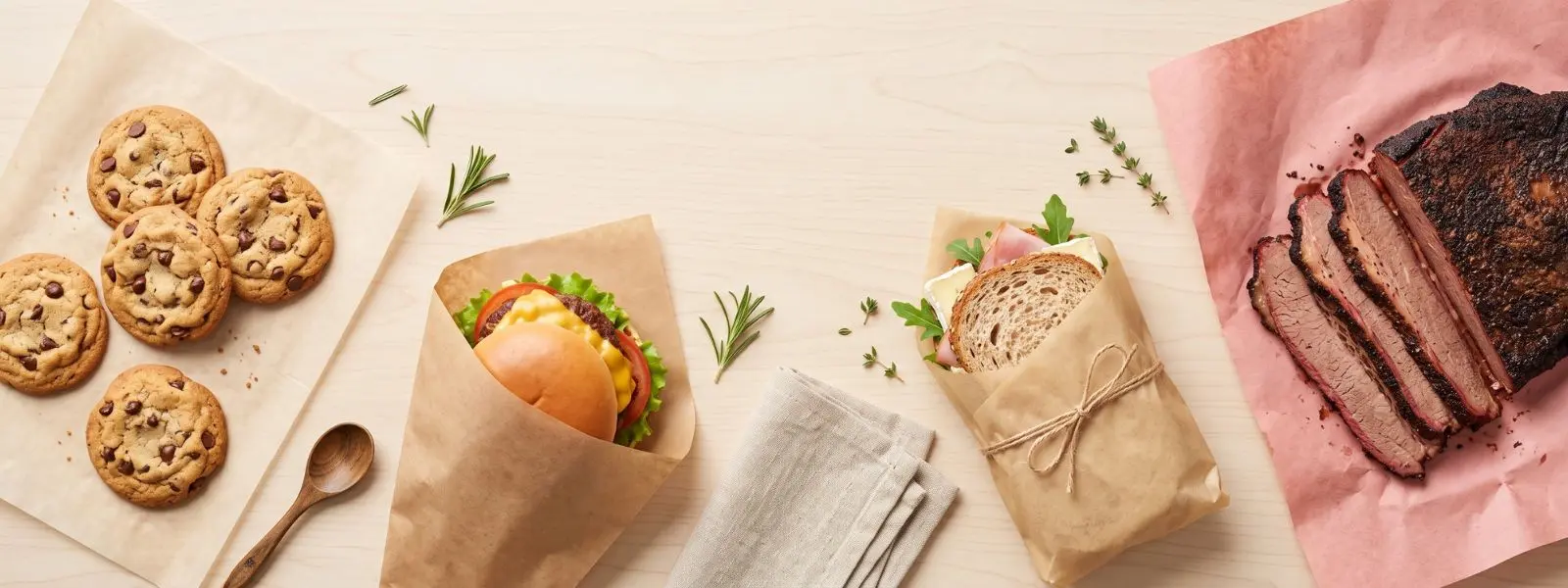
Food grade paper is paper or paperboard manufactured and tested to sit in direct contact with food without transferring harmful substances into it. It covers the sheets, rolls, liners, and wraps used across restaurants, delis, bakeries, and food trucks — from greaseproof burger wrap to silicone-coated baking parchment. What separates it from ordinary craft or printing paper is not the look of the sheet but the raw materials, coatings, and inks used to make it, all of which must clear defined food-contact regulations.
Food grade paper is a food-contact paper or paperboard produced so that no harmful chemicals migrate into food, regulated in the United States under FDA 21 CFR 176.170 for aqueous and fatty foods and 21 CFR 176.180 for dry foods.
That regulatory split is the ground truth most guides skip. Section 176.170 governs the substances allowed on the food-contact surface of paper that touches wet, oily, or fatty foods, while 176.180 covers paper that touches dry foods only. Compliance is verified through extractives and migration testing on the finished sheet — a paper is not “food safe” because a label says so, but because its composition and test records support the claim. This guide breaks down what qualifies paper as food grade, the main types in commercial use, the current PFAS rules every buyer now needs to know, and how to match the right paper to your menu.
What Makes Paper “Food Grade”?
Paper qualifies as food grade when every component that can reach food is cleared for food contact and the finished sheet passes migration testing. Three requirements sit behind that status, and all three must hold at once.
First, the base fibre must be non-toxic. Most food grade paper is made from virgin kraft pulp rather than recycled stock, because recycled fibre can carry mineral oils and contaminants from its previous life as printed matter. Second, any coating, ink, or adhesive applied to the sheet must itself be food-contact compliant — a compliant base paper printed with a non-compliant ink is no longer food safe. Third, the finished material must be backed by test evidence, not marketing language.
Food-contact surface and migration testing
The regulated part of any food grade sheet is the food-contact surface — the side that touches the product. Under 21 CFR 176.170, that surface is assessed through extractives testing, where the paper is exposed to solvents that simulate aqueous and fatty foods to measure what leaches out. If the extractive levels stay within the limits set for the intended food type, the paper clears for that use. This is why a supplier should be able to produce a compliance statement or test report on request, and why “food grade” without documentation carries no real weight.
Coatings, inks, and adhesives count too
A grease barrier, a print, or a glued seam can each introduce a substance that migrates into food. Coatings such as wax, polyethylene (PE), and silicone must be applied within cleared parameters, and food-safe inks are formulated to resist migration and rub-off onto the product. When you print a logo on a sandwich wrap, the ink sits on a food-contact surface, so it has to meet the same standard as the paper beneath it. Treating the print and coating as part of the food-safety question — not a cosmetic afterthought — is what genuinely separates a compliant supplier from a risky one.
What Are the Main Types of Food Grade Paper?
Food grade paper is not one product but a family of papers, each engineered around a specific barrier property — grease resistance, moisture control, heat tolerance, or breathability. Choosing the wrong one turns a good product soggy, greasy, or stuck to its wrapper. The six types below cover the vast majority of commercial food packaging.
Greaseproof paper
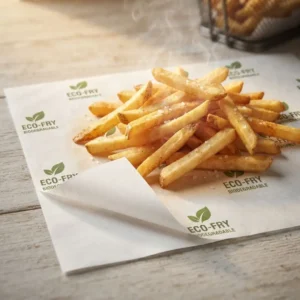
Greaseproof paper resists oil and grease penetration and is the default wrap for fast food, fried items, and oily bakes. Its barrier comes from the papermaking process itself — the pulp is heavily beaten so the fibres compact into a dense sheet that blocks fat — rather than always relying on a coating. Grease resistance is measured on the Kit Rating scale (0–12 under TAPPI T559), where a higher number means stronger resistance; standard deli and fast-food applications typically sit in the mid-to-upper range. Common weights run roughly 30–45 gsm for wraps and liners.
Butcher and kraft paper
Butcher paper is a food grade kraft paper first developed to wrap raw meat, poultry, and seafood, and now used well beyond the meat counter. Made from virgin kraft pulp, it is prized for breathability — it lets meat release moisture instead of trapping it, which protects surface texture during storage. Weights commonly range from about 40–60 gsm for wrapping duty. Uncoated kraft also serves as tray liners, sandwich inner-wraps, and bakery packaging where a natural look is wanted.
Parchment paper
Parchment paper is a silicone-coated, heat-resistant paper built for baking and hot-line use. The silicone layer gives it a non-stick surface and lets it hold up in the oven, with most commercial baking parchment rated oven-safe to around 450°F (232°C). It lines sheet pans, separates baked goods, and wraps hot items without sticking. Unlike wax paper, parchment is designed for direct heat exposure.
Wax paper
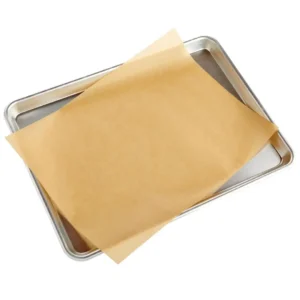
Wax paper carries a wax coating that creates a moisture and light grease barrier, making it useful for cold and room-temperature wrapping — sandwiches, candies, and interleaving. The critical limitation is heat: wax paper is not oven-safe, because the coating softens and melts under high temperature. Buyers who need a heatproof sheet should reach for parchment, not wax paper. Soy-wax versions offer a compostable alternative to traditional paraffin coatings.
Freezer paper
Freezer paper pairs a paper face with a polyethylene coating on one side, giving it a strong moisture barrier for cold storage. The PE layer blocks freezer burn and locks in moisture, while the uncoated paper face can still take a label or print. It is the standard choice for portioning and freezing meat and fish. Its coated structure makes it more of a barrier product than a breathable one, which is the opposite priority to butcher paper.
Deli and cheese paper

Deli paper is a lightweight food grade sheet for sandwich and counter wrapping, valued for a clean fold and a printable face. Cheese paper is a specialist two-ply construction that balances moisture retention with breathability, letting cheese respire without drying out or sweating. Both prioritise short-term freshness and presentation over long-term barrier strength. For branded counter service, these are the sheets that carry a logo in front of the customer.
Is Food Grade Paper FDA Approved and PFAS-Free?
Food grade paper is regulated by the FDA rather than “approved” as individual products, and as of 2025 the category is effectively PFAS-free in the U.S. market. The distinction matters: the FDA does not issue an approval stamp for each wrap; instead it clears the substances allowed on food-contact paper through 21 CFR Part 176, and manufacturers must be able to show their materials fall within those cleared substances and pass extractives testing.
The PFAS story is the most important recent shift for buyers. PFAS — per- and polyfluoroalkyl substances, often called “forever chemicals” — were used for years as grease-proofing agents in items like fast-food wrappers, microwave popcorn bags, and takeout paperboard. In February 2024, the FDA announced that grease-proofing substances containing PFAS were no longer being sold by manufacturers for food-contact use in the U.S., completing a voluntary phase-out and removing what the agency called the primary source of dietary PFAS exposure from authorized food-contact uses.
The tightening continued into 2025. In January 2025, the FDA determined that 35 food-contact notifications tied to PFAS grease-proofers were no longer effective, and it developed a screening method to detect PFAS grease-proofing agents in paper and paperboard. A compliance date of June 30, 2025 was set to allow existing paper stock produced before the change to clear the supply chain. Several states — including California, New York, Colorado, and Maine — layer their own bans on intentionally added PFAS in plant-fibre packaging on top of the federal shift.
For a food business, the practical takeaway is simple: PFAS-free, or fluorine-free, is now the baseline expectation for food grade paper, not a premium upgrade. When sourcing, ask suppliers to confirm fluorine-free grease resistance in writing, especially if you sell into states with their own screening thresholds. A modern greaseproof sheet should deliver its barrier through fibre density or a compliant non-fluorinated treatment not legacy PFAS chemistry.
Which Food Grade Paper Should You Use for Your Menu?
The right paper is decided by the food it wraps: its grease level, moisture, temperature, and how long it needs to hold. Matching the barrier property to the product is what prevents soggy wraps and grease bleed-through. Use the table below as a starting decision guide, then confirm weight and coating with your supplier.
Food Packaging Paper Specification Matrix
Recommended paper grades, density (GSM), and barrier priorities by food application.
| Food / Use Case | Recommended Paper | Typical GSM | Barrier Priority |
|---|---|---|---|
| Burgers, fried chicken, oily snacks | Greaseproof | 30–45 | Grease resistance |
| Raw meat, poultry, seafood | Butcher / Kraft | 40–60 | Breathability |
| Baked goods on the pan, hot line | Parchment (silicone) | 35–50 | Heat + Non-stick |
| Sandwiches, candy, cold interleaving | Wax paper | 25–40 | Moisture (cold only) |
| Frozen meat and fish portions | Freezer paper (PE) | 50–70 | Freeze / Moisture lock |
| Deli counter, sandwich shops | Deli paper | 25–40 | Fold + Print |
Weight (GSM) is the second lever after paper type. As a rough tiering: lightweight sheets around 25–35 gsm suit tray lining and light bakery wrap; standard 35–50 gsm covers most deli and sandwich work; and heavier 50 gsm and up handles wet, greasy, or heavy items that would soak through a thinner sheet. Heavier is not automatically better — an over-weight sheet on a light pastry wastes cost and stiffens the wrap. Specify the lightest weight that holds your product cleanly through service.
Food Grade Paper by Business Type
Different operations lean on different papers, and knowing the pattern for your segment shortens the sourcing decision.
Restaurants and diners
Restaurants usually run a small mix: greaseproof for fried and oily plates, kraft liners for baskets, and a printed deli sheet for anything handed across a counter. A single mid-weight greaseproof sheet often covers the majority of wrapping needs, which keeps stock simple. Branded wrap also doubles as a low-cost presentation upgrade on the plate.
Delis and sandwich shops
Delis live on deli paper and greaseproof sheets, where a clean fold and a printable face matter as much as the barrier. The wrap is part of the customer-facing product, so print quality and consistent sizing carry real weight here. Two-ply cheese paper is worth stocking if you sell cut cheese to go.
Bakeries and cafes
Bakeries rely on parchment for pan work and lightweight food grade tissue or butter paper for wrapping finished goods. Heat tolerance is the deciding property on the production side, while presentation drives the front-of-house wrap. Silicone parchment that holds up to around 450°F (232°C) is the workhorse.
Food trucks and quick service
Food trucks need fast, grease-tolerant wraps that hold up while a customer eats on the move. Greaseproof sheets and kraft baskets dominate, chosen for barrier strength over refinement. Compact roll or interfolded formats save space in a tight service window.
Frequently Asked Questions
Everything you need to know about food-grade paper standards and compliance.