
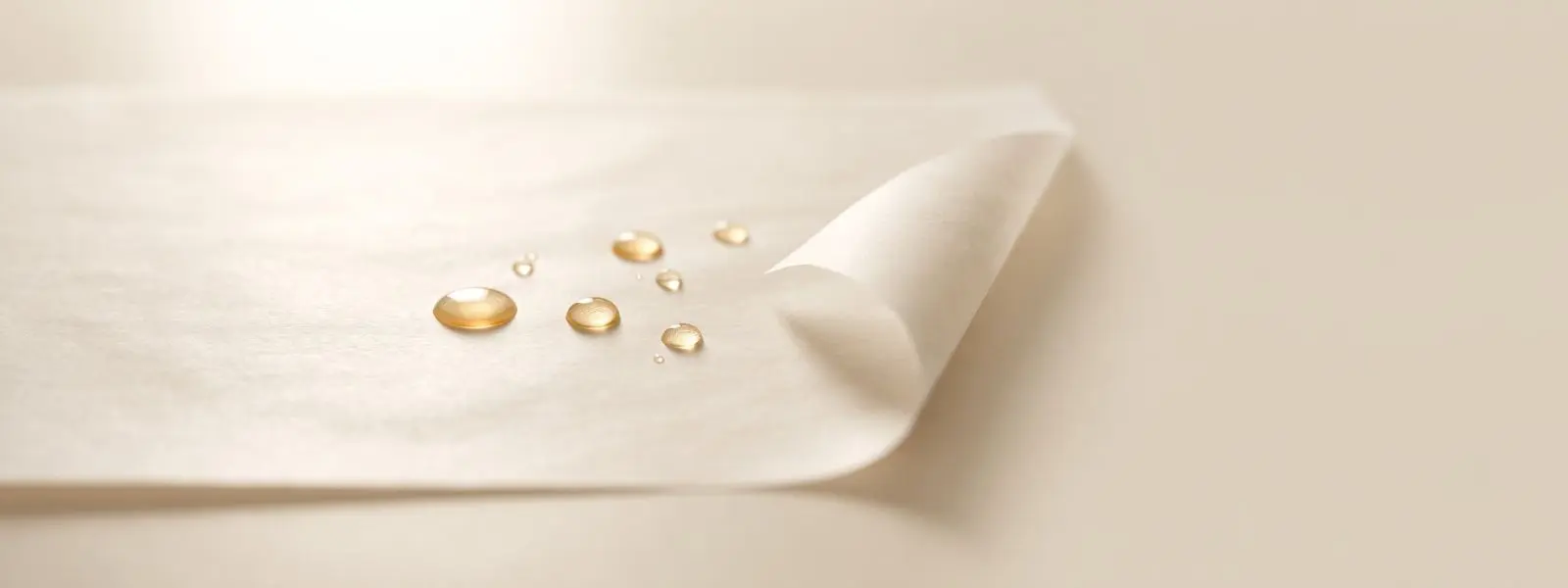
Greaseproof paper is a dense, oil-resistant food paper used to wrap and line greasy and fried foods without letting fat soak through. It is the sheet under a basket of fish and chips, around a burger, and lining a bakery tray. What sets it apart from most food wraps is where its barrier comes from: greaseproof paper resists oil through the structure of the paper itself, not through a wax or plastic coating layered on top.
Greaseproof paper is a food-contact paper made from highly refined cellulose fibres that are super-calendered into a dense, low-porosity sheet, which blocks oil and grease from passing through.
That density is the whole mechanism. During manufacture the pulp is heavily beaten so the fibres fibrillate and pack tightly, then the sheet is pressed under high-pressure rollers to compress it further and shrink its pore size. The result is a smooth, greaseproof surface that typically weighs around 30–50 gsm and stays breathable — a genuine barrier built into the fibre rather than sprayed onto it. This guide covers how greaseproof paper is made, how its grease resistance is measured, what it is used for, and the food-safety and PFAS rules that now apply to it.
What Is Greaseproof Paper Made Of?
Greaseproof paper is made from cellulose wood pulp that is highly refined and then densified by calendering, with no coating required for its core grease barrier. The process is the reason it works, so it is worth understanding in plain terms.
The pulp is first put through intense refining, which frays and fibrillates the cellulose fibres so they bond into a tight, closely-woven web. That refined sheet is then super-calendered — passed through a stack of heated high-pressure rollers that compress the fibres, raise the density, and reduce the thickness. The compression collapses the tiny gaps between fibres, and it is those shrunken pores that stop oil molecules from migrating through the sheet. Because the barrier is mechanical, the paper keeps a natural, uncoated feel and remains recyclable and breathable.
The role of sizing agents
To close off the last of the micro-porosity, manufacturers can add sizing agents during production. These are hydrophilic polymers that integrate into the fibre rather than sit on top as a separate layer, filling residual voids and forming a film around the fibres that impedes grease migration. Because the sizing is built in rather than coated on, the sheet keeps its breathability — an important distinction from wax and PE papers, which add a distinct surface film. This is also where PFAS chemistry historically entered the picture, which is covered below.
Greaseproof, glassine, and vegetable parchment
Greaseproof paper sits in a small family of papers made by the same fibre-densifying route. Glassine is greaseproof paper taken further under calendering, producing an even smoother, glossier, more translucent sheet used as candy and bakery liners. Genuine vegetable parchment is a different branch — the pulp is acid-treated to gel and reform the fibre surface, creating a wet-strong, heat-tolerant baking paper. Knowing this family tree helps buyers avoid mixing up greaseproof with silicone-coated parchment, which is engineered for oven heat rather than grease wrapping.
How Is Greaseproof Paper’s Grease Resistance Measured?
Grease resistance in food paper is measured mainly by the Kit Rating, a standardised scale that tells you how well a sheet holds back oil. Numbers replace vague claims here, and specifying them is what separates a professional order from guesswork.
The Kit Rating runs from 0 to 12 under the TAPPI T559 test, where a numbered series of increasingly aggressive oil-and-solvent mixtures is applied to the surface and the highest one the paper resists becomes its rating. A higher number means stronger grease resistance: lighter wrapping and lining tasks are satisfied by mid-scale ratings, while very oily, hot, or long-hold foods call for a higher Kit value. Alongside it, the Cobb value (ISO 535) measures how much water the surface absorbs over a set time, which matters for moist and saucy foods. Requesting a target Kit Rating and GSM together is the cleanest way to match paper to the food it has to survive.
What Is Greaseproof Paper Used For?
Greaseproof paper is used to wrap, line, and separate greasy or fried foods across food service, retail, and baking. Its combination of a built-in oil barrier and a printable, breathable surface makes it one of the most versatile food papers in a commercial kitchen.
- Fried and fast food — fish and chips, fries, fried chicken, and onion rings, where oil bleed-through would ruin both the food and the packaging.
- Burgers and hot sandwiches — an inner wrap that holds heat and contains grease without going limp.
- Bakery and pastry — lining trays and separating croissants, doughnuts, and other buttery bakes.
- Basket and tray liners — a printed sheet that lifts presentation in diners, pubs, and quick-service venues.
- Deli and counter — wrapping cured meats and oily prepared foods for takeaway.
Greaseproof paper by business type
Restaurants and diners lean on mid-weight greaseproof for fried plates and basket liners, often as a single printed sheet that covers most wrapping. Fish and chip shops and food trucks need higher grease resistance and fast, one-handed wrapping for hot, oily portions eaten on the move. Bakeries and cafes use lighter greaseproof and glassine for tray lining and separating delicate bakes. Across all three, a branded greaseproof sheet doubles as low-cost, food-safe marketing that reaches the customer’s hands.
Is Greaseproof Paper PFAS-Free and Food Safe?
Modern greaseproof paper produced for the U.S. market is PFAS-free, and food-safe grades are regulated under FDA 21 CFR 176.170 for contact with aqueous and fatty foods. Both points deserve attention because greaseproof paper sat at the centre of the PFAS packaging problem.
For years, some grease-proofing agents used PFAS — per- and polyfluoroalkyl “forever chemicals” — to boost oil resistance, particularly in fast-food wrappers and takeout paper. In February 2024, the FDA announced that PFAS grease-proofing substances were no longer being sold by manufacturers for food-contact use in the U.S., completing a voluntary phase-out the agency described as removing the primary source of dietary PFAS exposure from authorized food-contact uses. In January 2025, the FDA confirmed that 35 food-contact notifications tied to those PFAS grease-proofers were no longer effective and set a June 30, 2025 date to clear older stock, and several states apply their own limits on intentionally added PFAS in fibre packaging.
The practical result is that a greaseproof sheet should now earn its barrier from dense, calendered fibres and non-fluorinated sizing — not legacy PFAS chemistry. When you buy, ask for written confirmation that the paper is fluorine-free and 176.170 compliant, especially if you sell into states with their own screening thresholds. Where a print carries your logo, confirm the ink is food-safe too, since it shares the food-contact surface.
How Greaseproof Differs from Wax and Parchment
| Paper | Barrier Source | Heat Use | Best For |
|---|---|---|---|
| Greaseproof | Dense calendered fibre (no coating) | Wrapping / lining, not high oven heat | Fried, oily, greasy foods |
| Wax paper | Wax coating | Cold / room temp only — not oven-safe | Sandwiches, candy, cold interleaving |
| Parchment | Silicone coating | Oven-safe to ~450°F (232°C) | Baking, non-stick pan lining |
Frequently Asked Questions
Everything you need to know about greaseproof paper properties, safety, and customization.
Is greaseproof paper the same as parchment paper?
Does greaseproof paper have a wax or plastic coating?
Is greaseproof paper PFAS-free?
What GSM is greaseproof paper?
Can you microwave or oven-bake with greaseproof paper?
Can greaseproof paper be printed with a logo?
Need branded, PFAS-free greaseproof paper for your kitchen?
Explore custom greaseproof paper, our PFAS-free greaseproof grade, and printed food basket liners. Request a food-safe digital proof before your run.