
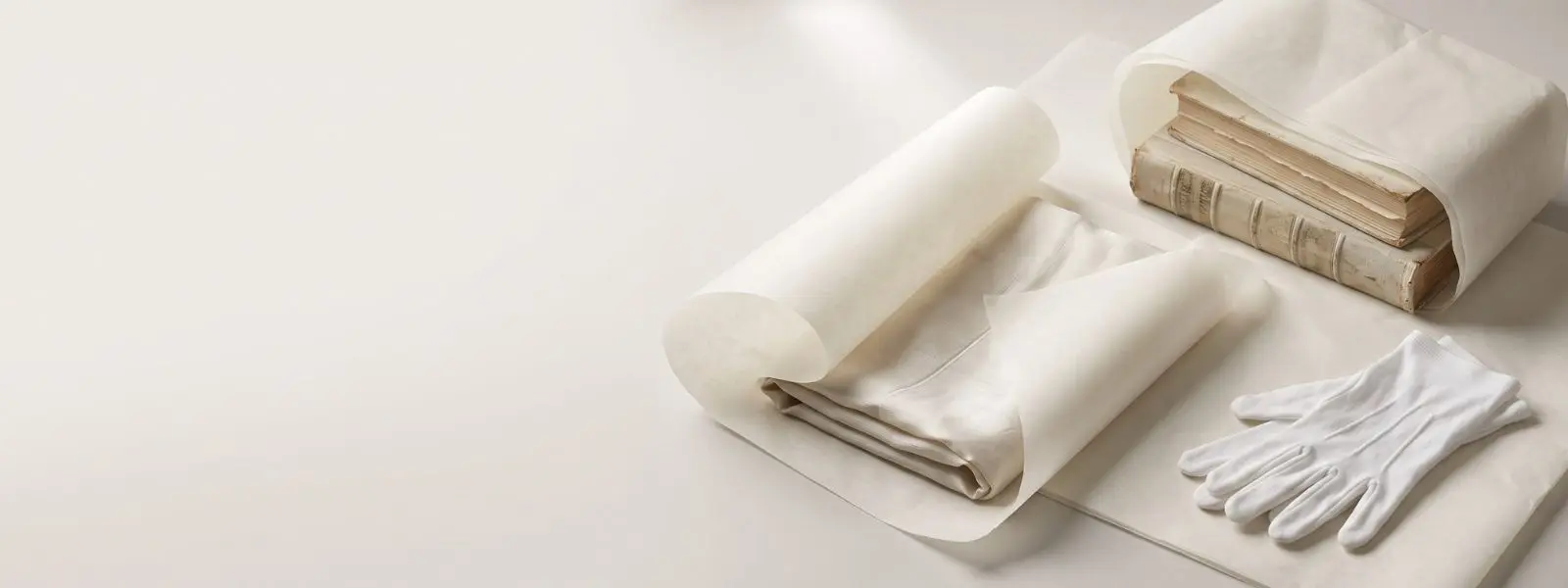
Acid-free tissue paper looks identical to ordinary tissue, but it does something ordinary tissue cannot: it protects what it wraps from slow chemical damage. For businesses packaging apparel, jewellery, keepsakes, or anything a customer will store, the difference decides whether the item arrives pristine and stays that way — or yellows, tarnishes, and degrades in the box.
Acid-free tissue paper is pH-neutral, lignin-free (and usually sulfur-free) tissue that will not yellow, tarnish, or chemically degrade the items it wraps, making it essential for delicate, valuable, or long-stored products. Standard tissue is mildly acidic and does the opposite over time.
The science is straightforward. Ordinary paper contains lignin and sometimes sulfur compounds that release acids as they age, and those acids migrate into whatever the paper touches — turning fabrics brittle and yellow, tarnishing silver, and fading photographs. Acid-free tissue removes those substances and holds a neutral pH, halting the reactions before they start. This guide explains what acid-free tissue is, why it matters for packaging, which products need it, and the crucial buffered-versus-unbuffered distinction most guides skip.
What Is Acid-Free Tissue Paper?
Acid-free tissue paper is tissue manufactured to a neutral pH — typically around 6.5 to 7 — with acidic components removed so it stays chemically stable over time. It is engineered for protection, not just presentation.
Two things make tissue acid-free. First, it is lignin-free: lignin is a natural component of wood pulp that breaks down into acids as it ages, causing paper to yellow and grow brittle, so removing it keeps the sheet stable. Second, quality acid-free tissue is usually sulfur-free, because sulfur compounds tarnish metals — a sulfur-free sheet is anti-tarnish, which matters for jewellery and silverware. Many grades are made from virgin alpha-cellulose pulp for purity and contain no optical brighteners. The result is a soft, thin tissue that maintains its own colour and strength and, more importantly, does not attack the items it protects. Ordinary tissue, by contrast, is mildly acidic and degrades both itself and its contents over time.
Why Does Acid-Free Tissue Paper Matter for Packaging?
Acid-free tissue matters because acids cause premature, irreversible damage to delicate goods, and a neutral pH stops that damage before it starts. For any product meant to last or be stored, the wrapping is part of the protection.
The failure mode is slow and invisible at first. Acids from standard tissue cause cellulose fibres to break down, so fabrics yellow and turn brittle, photographs fade and discolour, paper documents embrittle, and metals tarnish. Worse, acids migrate — they transfer from an acidic wrapper into the item it touches, so the packaging itself becomes the source of damage. Acid-free tissue’s neutral pH halts these chemical reactions, preserving the colour, texture, and integrity of the contents. For a business, that is not a niche concern: it protects the perceived quality of the product a customer unwraps weeks later, prevents returns and complaints over discolouration, and signals a brand that thinks about longevity. When you sell something meant to be kept, acid-free tissue protects your reputation as much as the product.
What Products Need Acid-Free Tissue Paper?
Acid-free tissue paper is essential for delicate, valuable, or long-stored items that acids would damage over time. If a product will sit wrapped for weeks or be kept by the customer, it likely needs it.
- Apparel and textiles — garments, knitwear, silk, wool, wedding dresses, heirloom fabrics, and anything prone to yellowing or creasing.
- Jewellery and metals — silver, plated, and metal pieces that tarnish; sulfur-free tissue is anti-tarnish.
- Photographs and prints — black-and-white and colour photos, art prints, and giclées that fade or discolour.
- Paper and documents — certificates, letters, maps, and stationery that embrittle.
- Leather goods — bags, shoes, and accessories that need stable, non-acidic contact.
- Luxury, bridal, and heirloom items — anything premium the customer will store or keep as a keepsake.
For everyday, quickly-used items — a food wrap or a low-cost impulse product — standard tissue is usually fine. The moment the product is delicate, valuable, or stored, acid-free becomes worth the small upgrade.
Buffered vs Unbuffered Acid-Free Tissue: Which Do You Need?
Use buffered acid-free tissue for cellulose-based items like cotton, linen, and paper, and unbuffered for protein-based items like silk, wool, and leather, plus certain photos and metals. Getting this wrong can damage the very item you meant to protect.
Buffered tissue contains an alkaline reserve — usually around 2–3% calcium or magnesium carbonate, giving a pH near 8.5 — that neutralises acids migrating from the item or the environment. That protective buffer is ideal for plant-based (cellulose) materials such as cotton, linen, and wood-pulp or rag paper. Unbuffered tissue is pH-neutral with no alkaline reserve, and it is the correct choice for protein-based (animal) materials, because silk, wool, and leather can react badly to alkaline buffers. Unbuffered is also preferred for certain photographic processes (such as cyanotypes and dye-transfer prints) and for metals, where its anti-tarnish neutrality is safest. Two practical rules: when the fibre content is unknown, choose unbuffered as the safe default; and remember that a buffer depletes over time, so long-term storage tissue should be checked and refreshed periodically.
| Material | Use | Why |
|---|---|---|
| Cotton, linen, paper, documents | Buffered | Alkaline reserve resists acid migration |
| Silk, wool, leather | Unbuffered | Protein reacts poorly to alkaline buffers |
| Colour photos, cyanotypes, dye-transfer | Unbuffered | Certain processes need neutral, not alkaline |
| Silver, plated metals, jewellery | Unbuffered | Neutral, anti-tarnish contact |
| Unknown fibre content | Unbuffered | Safe default |
How to Choose Acid-Free Tissue Paper
Choose acid-free tissue by confirming three labels — acid-free, lignin-free, and (for metals) sulfur-free — then selecting buffered or unbuffered to match your material. A little verification prevents a costly mismatch.
Look for the paper to be explicitly stated as acid-free and lignin-free, ideally with a stated pH, and sulfur-free if you are wrapping jewellery or silver. Match the buffer to the item using the table above, defaulting to unbuffered when unsure. For genuine long-term protection, source from suppliers who specialise in conservation-grade materials rather than treating “acid-free” as a marketing word, and pair the tissue with stable, climate-controlled storage where possible. For custom, branded acid-free options, see acid-free tissue paper within the full custom tissue paper range, and the custom tissue paper guide for weights and printing.