
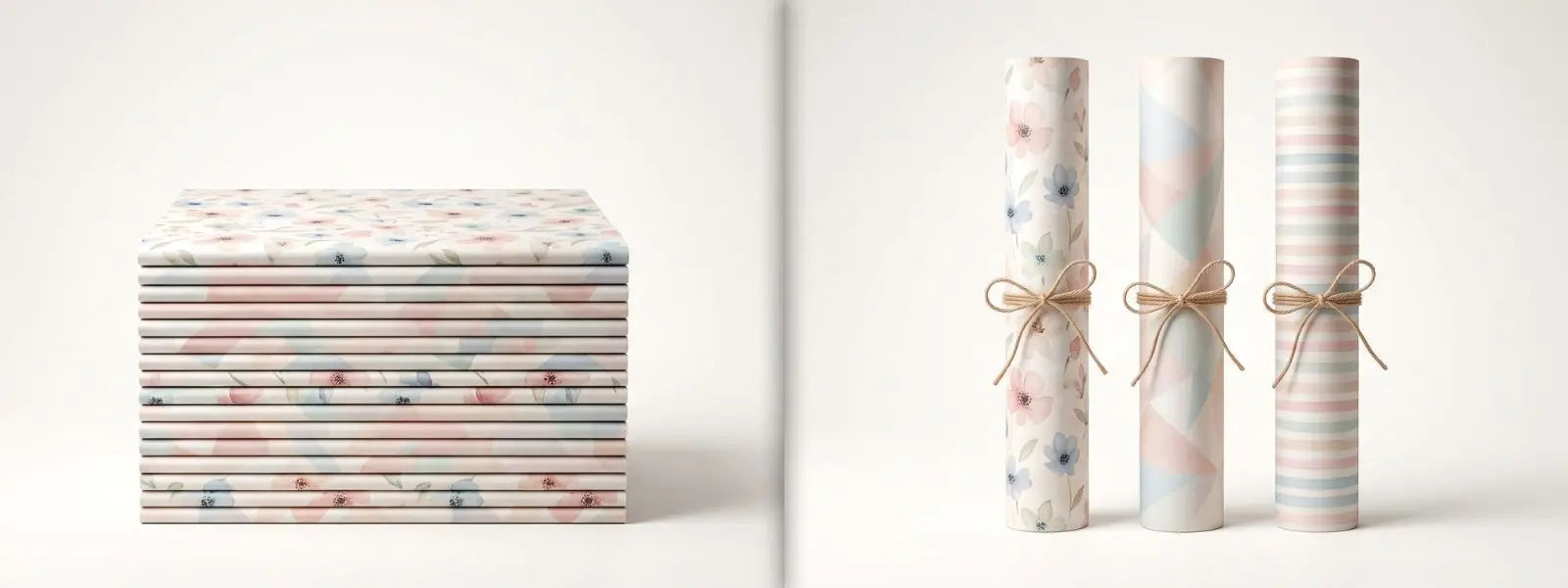
Custom wrapping paper turns a gift or product into a branded moment — the opaque, printed sheet that covers what is inside and carries a logo to the recipient. For a business, the first practical decision is not the design but the format: sheets or rolls. That single choice shapes wrapping speed, waste, storage, and cost across every order you pack.
Choose wrapping paper sheets for consistent product sizes, premium flat presentation, and easy storage; choose rolls for varied or large item sizes, high-volume continuous wrapping, and lower waste per length. Most businesses pick based on how uniform their products are and how much they wrap.
Unlike thin, translucent tissue paper — which cushions and layers inside a box — wrapping paper is heavier and opaque, made to fully cover and conceal a gift or product. It runs roughly 40 to 120 GSM depending on grade, prints in full colour, and comes in matte or gloss finishes. This guide covers what businesses use custom wrapping paper for, the sheets-versus-rolls decision in depth, the right weight and finish, sizes, and how to order. If you also need an inner layer, see custom tissue paper.
What Is Custom Wrapping Paper Used For in Business?
Custom wrapping paper is used by businesses to wrap retail purchases, corporate gifts, and products in branded paper that reinforces identity and elevates presentation. It works wherever a covered, gift-style finish adds value.
Common business uses include retail gift wrapping at the counter, corporate and client gifting during holidays or employee-appreciation events, boutique product packaging for items like homeware or apparel, seasonal and holiday programs, gift hampers and baskets, and e-commerce orders that arrive gift-ready. The branding logic is simple: a logo, brand colour, or repeating pattern printed across the wrap makes every package recognisable and shareable — and “unwrapping” posts are a common social-media trend that puts your brand in front of a wider audience. Some businesses even sell branded wrapping paper as a product in its own right through gift shops or online. In each case, custom wrapping paper converts a functional cover into a brand impression.
Sheets vs Rolls: Which Wrapping Paper Format Should You Choose?
Choose sheets when your products are a consistent size and presentation matters most; choose rolls when sizes vary, volume is high, or you wrap continuously. Each format solves a different operational problem, so the right answer depends on how you actually pack.
Wrapping paper sheets are pre-cut flat sheets. They store flat without curling, drop straight onto a consistent product for fast, tidy wrapping, and support clean edge-to-edge printing for a premium finish. They suit pre-packed retail, boutiques, florists, and any business wrapping a repeatable size, and they are easy to sort and distribute by design. The trade-off is less flexibility for varied sizes and the need for accurate count and stack handling.
Wrapping paper rolls are cut-to-length on demand. They flex to any product size, reduce waste on large boxes by avoiding fixed sheet dimensions, and support high-volume, continuous wrapping — the reason retail stores, chains, and seasonal programs favour them. The trade-offs are curl, the need to cut each piece, and roll storage space.
| Factor | Sheets | Rolls |
|---|---|---|
| Best for | Consistent product sizes | Varied or large sizes |
| Volume | Low–medium, pre-packed | High, continuous |
| Waste | Low for known sizes | Low for mixed sizes |
| Storage | Flat, tidy | Compact roll, but curls |
| Wrapping speed | Fast for uniform items | Flexible, needs cutting |
| Presentation | Premium, edge-to-edge print | Standard, practical |
| Typical users | Boutiques, florists, gift shops | Retail chains, seasonal programs |
A practical rule: if most of what you wrap is the same size, sheets are faster and look more finished; if sizes vary widely or you wrap in bulk, rolls waste less and move quicker. Many businesses keep both — sheets for a signature product and a roll for everything else.
What Weight and Finish Should Business Wrapping Paper Be?
Business wrapping paper should be heavy enough to be opaque and tear-resistant yet light enough to fold cleanly — usually 70 to 100 GSM — in a matte or gloss finish chosen to match the brand. Weight and finish together set the feel.
On weight, lightweight papers (40–60 GSM) are flexible and decorative but can be flimsy and may need double-layering; medium weights (70–90 GSM) balance durability and printability and are the popular default for gift and retail wrap; and heavy papers (100–120 GSM and up) suit luxury and premium presentation. Opacity matters: proper wrapping paper should hide what is inside, so both matte and gloss grades are made opaque. On finish, matte (uncoated) reads minimalist, natural, and classic — and tape and adhesives bond to it well — while gloss (coated) is shiny, reflective, and reads luxurious and polished; satin sits between the two. Choose matte for a subtle, modern or eco look and gloss for a vibrant, premium one, and confirm the finish suits your artwork, since heavy dark coverage and metallic effects perform differently across surfaces.
What Sizes Do Custom Wrapping Paper Sheets and Rolls Come In?
Custom wrapping paper comes in standard sheet sizes and roll widths, sized to the products you wrap. Sheets commonly run around 20″ × 29″, 20″ × 30″, or 22″ × 30″ (roughly 50 × 70 cm), with larger formats up to about 70 × 100 cm for luxury packaging. Rolls are typically 27–30 inches wide (some from 30 cm up to 70 cm) and 10–50 feet long, with much longer lengths for wholesale.
Sizing logic mirrors the format choice. For sheets, pick a size that wraps your most common product with enough overlap to fold and seal cleanly — too small forces awkward joins, too large wastes paper. For rolls, a wider roll reduces seams on big boxes, while length is chosen for how much you wrap between changes. When products vary a lot, a roll’s cut-to-length flexibility usually beats stocking multiple sheet sizes. Confirm exact dimensions with your supplier, and remember many will cut custom sizes to fit a specific product line.
How to Order Custom Printed Wrapping Paper
Ordering custom wrapping paper means choosing format and specs, preparing print-ready artwork, and approving a proof before production. Getting the file right the first time avoids reprints.
Decide format (sheets or rolls), weight (GSM), and finish (matte or gloss) first, then prepare artwork to the printer’s requirements — typically full-colour CMYK, high resolution (300 dpi or more), with a small bleed so the design runs edge-to-edge. Choose water-based, non-toxic inks, which matter especially for children’s gifts or any food-adjacent use. Confirm minimum order quantity and lead time, and consider pairing the wrap with matching stickers, ribbon, or tissue for a cohesive, sealed presentation. Ordering the wrap alongside coordinated elements keeps the whole package on-brand from the outside in.
Explore custom wrapping paper, including wrapping paper sheets and wrapping paper rolls, and pair with custom tissue paper for an inner layer.