
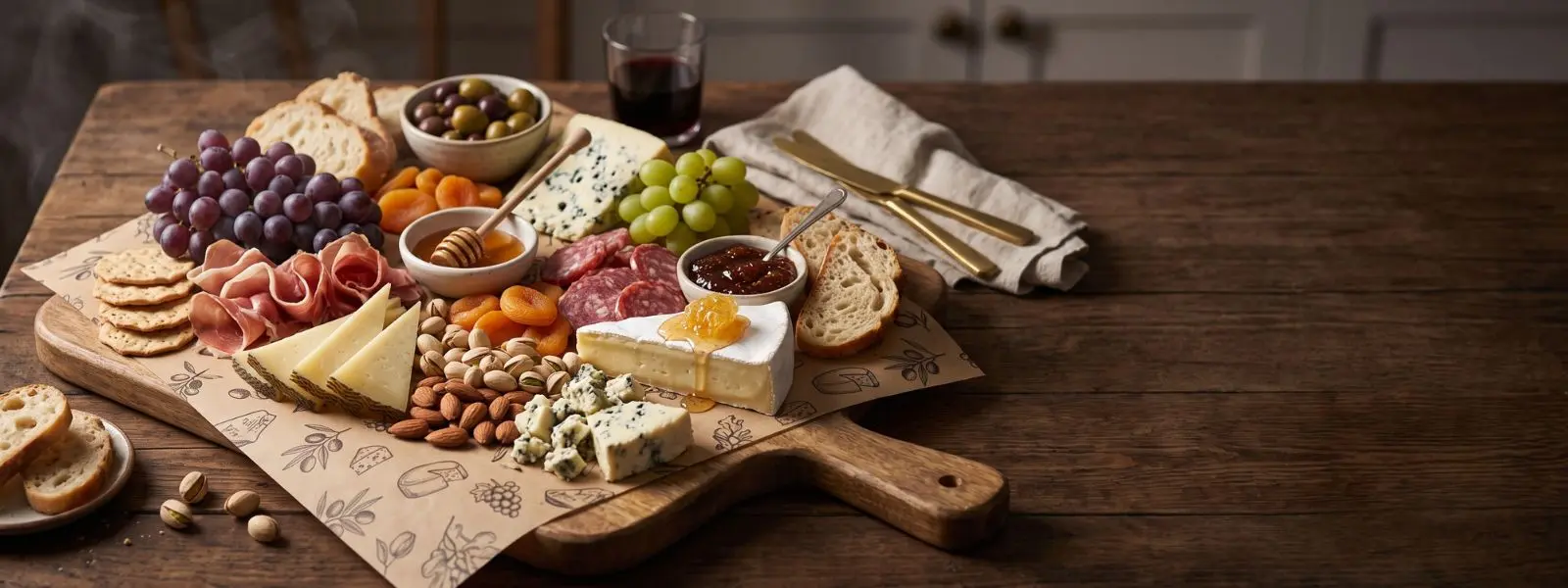
The charcuterie and grazing business runs on presentation. A board or box of cured meats, cheeses, fruit, and nuts sells on how it looks — and the paper underneath is part of the picture. Custom charcuterie paper lines and presents boards and grazing boxes with a food-safe, grease-resistant surface that keeps oils in check and puts your brand into every photograph a customer takes.
Custom charcuterie paper is food-grade, grease-resistant paper used to line and present charcuterie boards and grazing boxes. It handles the oils from cheeses, cured meats, and dressings, comes in kraft, white, or black for different aesthetics, and can be printed with your logo. It is equal parts function and styling.
For grazing-box businesses, caterers, and charcuterie makers, the right paper protects the presentation and reinforces the brand. This guide covers what it is, the materials and colors, and how to use it.
What is charcuterie paper, and why use it?
Charcuterie paper is a food-grade, grease-resistant sheet used to line boards, boxes, and grazing tables, protecting the surface and framing the food. Charcuterie is oily — soft cheeses, cured meats, olives, and dressings all release fat — so the paper needs to resist grease without soaking through.
Using it serves three purposes. It protects the board or box from oil and moisture, keeping the presentation clean and the container reusable or intact. It styles the spread, adding a deliberate, considered backdrop that makes the food look more abundant and premium. And it brands the moment, since a printed sheet carries your logo through the whole event and into the photos customers share. For a business where presentation is the product, charcuterie paper is a small detail that lifts the whole board. It is closely related to deli paper and greaseproof paper, specialized here for display rather than wrapping.
What materials and colors work best?
Charcuterie paper should be food-grade and grease-resistant, in a color chosen to flatter the food and match your brand — most often kraft, white, or black. Each color creates a distinct look.
Kraft gives a rustic, natural, artisanal feel that suits farmhouse and organic branding and photographs warm. White reads clean, fresh, and classic, letting colorful ingredients pop. Black is sleek and modern, giving an upscale, dramatic backdrop that makes bright cheeses and fruits stand out — increasingly popular for premium grazing. Whatever the color, the paper must be food-grade and FDA-safe for direct contact and grease-resistant enough to handle oily items without bleed-through, per the standard in what is food grade paper. Choose the color that best frames your typical spread and aligns with your brand’s aesthetic.
How do you brand and use charcuterie paper?
Print your logo or pattern on the paper and use it to line boards, wrap grazing boxes, and separate elements, turning presentation into branding. Because charcuterie is so photographed, branded paper earns real social visibility.
Practically, line the board or box base so the food sits on a clean, styled surface; wrap or line individual grazing boxes for takeaway; and use sheets to separate or frame components within a larger table. Printing keeps to a restrained logo or subtle pattern in food-safe inks, since a busy design competes with the food — the paper should frame the spread, not overpower it. A consistent branded paper across your boards, boxes, and packaging makes a grazing business look polished and cohesive. Order in the sizes that match your standard boards and boxes, and request a proof to check color and print against your typical food.
Is charcuterie paper food-safe and sustainable?
Yes — quality charcuterie paper is food-grade and can be recyclable or compostable when made from responsibly sourced fiber. Both safety and sustainability matter for a premium, values-driven grazing brand.
Confirm the paper is FDA-compliant for direct food contact and, for any grease-resistant coating, PFAS-free per current regulation. On sustainability, unbleached kraft and recyclable or compostable options reduce impact and reinforce a natural, artisanal identity, which fits the charcuterie aesthetic well. Pairing food-safe, sustainable stock with restrained branding gives you a board backdrop that is beautiful, safe, and responsible. Explore custom charcuterie paper and the deli paper range, and request a proof before your run.