
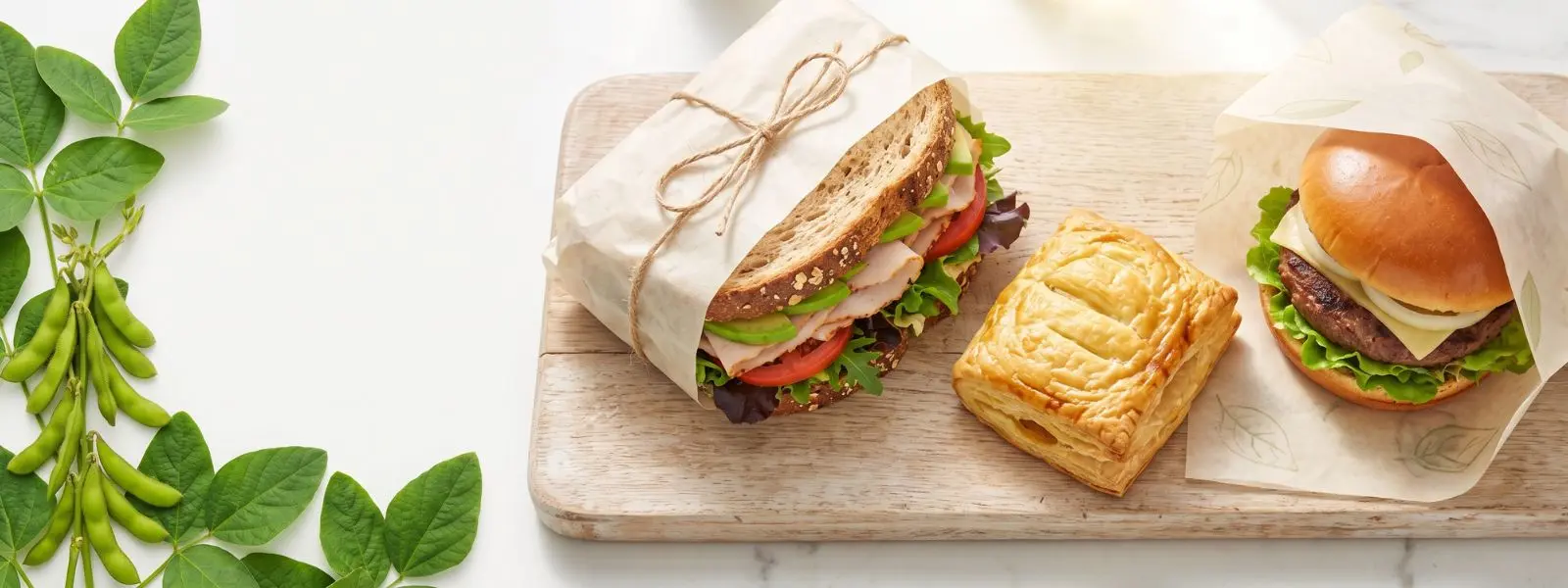
Wax paper is a food-service staple — it wraps sandwiches, lines baskets, and separates candies and cheese. But the coating that makes it work is usually petroleum-based paraffin, which does not compost and complicates recycling. Soy wax paper swaps that petroleum coating for a plant-based one, giving food businesses the same grease and moisture barrier with a materially better environmental profile.
Soy wax paper is food-grade paper coated with soybean-based wax instead of petroleum paraffin, making it a plant-based, compostable alternative that delivers the same grease and moisture barrier for cold and ambient food wrapping.
The soybean coating is the whole difference. Soy wax is renewable, non-toxic, and safe for food contact, and because it is organic it breaks down where paraffin cannot — a soy-coated sheet can compost, while a paraffin one heads to landfill and can foul the recycling stream. For a food business weighing sustainability against performance, soy wax paper is one of the cleanest swaps available. This guide covers what it is, whether it truly composts, how it compares to paraffin, why operators are switching, and what to check before you order.
What Is Soy Wax Paper?
Soy wax paper is a paper or kraft base coated with a thin layer of soybean-derived wax that repels grease and moisture. It sits in the wax-paper family but replaces the conventional petroleum coating with a plant-based one.
The base is typically food-grade kraft, often unbleached and available FSC-certified for responsible sourcing. Over that base, a soy wax coating provides the barrier: it keeps oil and moisture from passing through in either direction, which is what stops a wrapped sandwich going soggy or a greasy item bleeding through. Because soybean wax is renewable and non-toxic, the finished sheet is safe for direct food contact at cold and ambient temperatures. In short, it does the same job as classic wax paper while carrying a coating that composts rather than persists.
Is Soy Wax Paper Compostable and Biodegradable?
Yes — soy wax paper is compostable and biodegradable because both its paper base and its soybean wax coating are organic, unlike petroleum paraffin. This is the single biggest reason food businesses choose it.
The compostability comes down to the coating. Paraffin is petroleum-based, so it does not compost and interferes with paper recycling. Soybean wax is a renewable plant material, so a soy-coated sheet can break down into organic matter — under suitable conditions, plant-wax papers have been shown to degrade in roughly two to four weeks. One nuance matters for operators: full breakdown is often faster and more reliable in an industrial composting facility than in a backyard pile, and the wax’s structure means microbes still take time to digest it.
To back the claim, look for recognised compostability certifications rather than a vague “eco” label. In North America, BPI certification (based on ASTM D6400) signals industrial compostability; in Europe, EN 13432 is the equivalent standard. Requesting one of these, plus confirmation the base paper is unbleached or FSC-certified, is how you verify a genuine claim before buying.
How Does Soy Wax Paper Compare to Paraffin Wax Paper?
Soy wax paper matches paraffin’s grease and moisture barrier for cold and ambient wrapping while beating it on compostability, recycling, and sourcing. The table below sets them side by side.
| Attribute | Soy wax paper | Paraffin wax paper |
|---|---|---|
| Coating source | Plant-based (soybean), renewable | Petroleum-based, non-renewable |
| Compostable | Yes, under suitable conditions | No |
| Recycling-friendly | Better (organic coating) | Interferes with recycling |
| Food contact safety | Food-safe, non-toxic | Food-safe at low temp |
| Grease / moisture barrier | Comparable | Comparable |
| Oven-safe | No (wax melts) | No (wax melts) |
| Best use | Cold and ambient wrapping | Cold and ambient wrapping |
The key takeaway is that switching to soy does not cost you performance for everyday wrapping — the barrier is comparable. What changes is the end-of-life story and the sourcing. One shared limitation is heat: like all wax paper, soy wax paper is not oven-safe, because the wax softens and melts, so it belongs on cold and moderate-temperature applications. For baking heat, parchment remains the correct paper.
Why Are Food Businesses Switching to Soy Wax Paper?
Food businesses switch to soy wax paper to cut petroleum-based packaging, meet customer demand for sustainability, and strengthen their brand story — without changing how the paper performs at the counter. The drivers are practical, not just idealistic.
- Customer expectation — diners increasingly notice and reward compostable, plastic-free packaging, and a plant-based wrap signals that commitment on every order.
- Plastic and paraffin reduction — replacing petroleum-coated paper and plastic film with a plant-based sheet lowers reliance on fossil-based materials.
- Cleaner end-of-life — where composting is available, soy wax paper diverts waste from landfill in a way paraffin cannot.
- Brand differentiation — a printed, compostable wrap doubles as marketing that carries the sustainability message directly to the customer.
This aligns with the broader shift toward cleaner food packaging. Following the FDA’s 2024–25 phase-out of PFAS grease-proofers, food operators are already scrutinising what their paper is made of — and a plant-based, PFAS-free, compostable wrap fits that direction cleanly.
What Can Food Businesses Use Soy Wax Paper For?
Soy wax paper covers the same jobs as conventional wax paper across cold and ambient food service. Its plant-based coating does not limit where it can be used at normal temperatures.
Common applications include wrapping sandwiches, subs, and deli items; lining baskets, trays, and to-go boxes for presentation; separating and interleaving candies, chocolates, and cheese; and packaging baked goods and produce. Because the sheet takes a printed logo cleanly, it works equally well as a branded serving and takeaway wrap. As with any wax paper, keep it to cold and moderate temperatures and avoid oven use.
For the physical products, see natural soy wax paper, the full custom wax paper range, and wax paper sheets.