
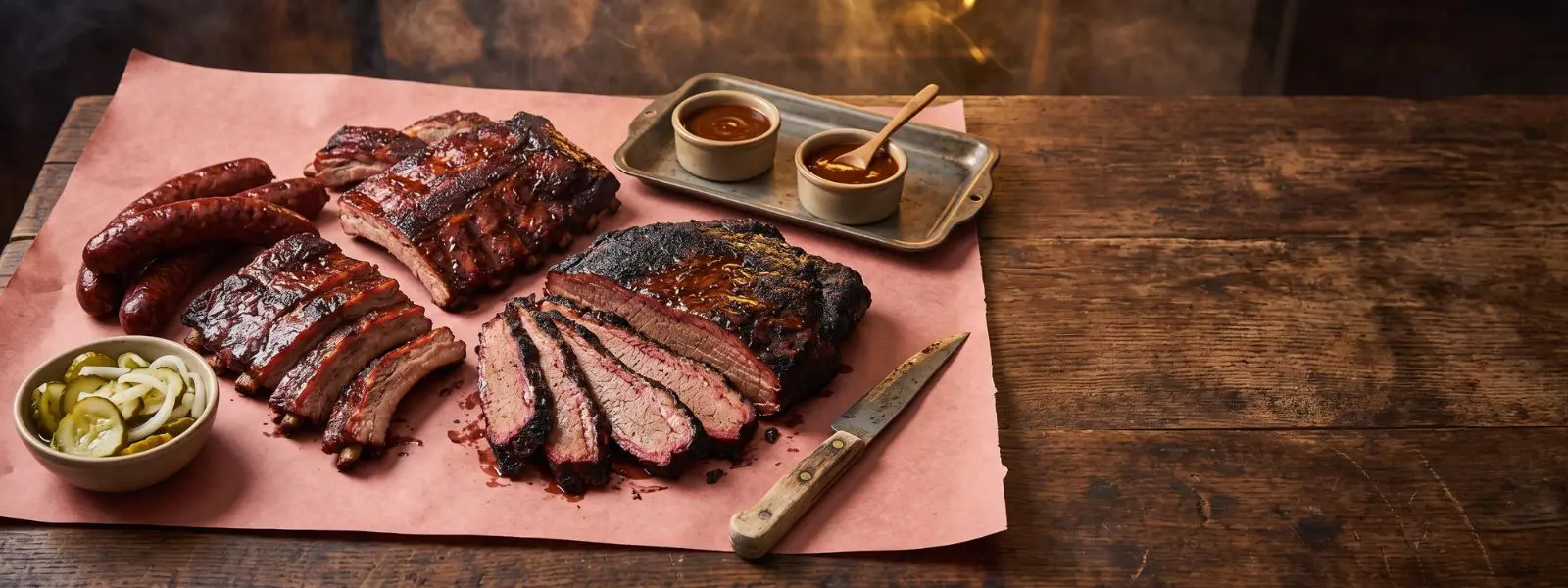
Butcher paper is the signature of a serious BBQ restaurant — it wraps the brisket through the stall, lines the tray under a pile of sliced beef, and carries the joint’s name to the customer’s hands. For a pit operation, the paper is not a commodity; the wrong grade ruins the bark, and a plain wrap misses an obvious branding moment. Getting both the function and the branding right is what this guide covers.
The right butcher paper for a BBQ restaurant is unbleached, unwaxed, uncoated, food-grade kraft — usually the pink or peach grade — because its breathability lets the bark stay firm and smoke keep penetrating, which foil cannot do.
That breathability is the whole reason pitmasters switched. Unlike aluminum foil, which seals the meat airtight and steams the bark into a soft, pot-roast texture, food-grade butcher paper lets excess moisture vapour escape while still holding enough heat to push meat past the stall. Pink “peach” paper — popularised by pitmaster Aaron Franklin — is a virgin-pulp kraft that is wet-strong and safe for direct food contact, and it is now the standard in competition and restaurant BBQ. This guide walks through why paper beats foil, which grade to buy, how to use branded paper across the cook and the serve, and exactly what to specify when ordering custom. If you first want the basics of how the paper works, see what is greaseproof paper.
Why Do BBQ Restaurants Use Butcher Paper Instead of Foil?
BBQ restaurants use butcher paper instead of foil because it is breathable, and that breathability is what protects the bark. Foil traps 100% of the steam; paper lets vapour exchange happen while still insulating the meat.
The practical results matter on the pit. Because paper is porous, excess moisture escapes instead of pooling, so the exterior stays firm and textured rather than turning soggy. Smoke keeps reaching the surface even after wrapping, so the meat holds its smoky flavour and develops a darker crust. At the same time, the paper creates a microclimate that retains natural juices and any spritz, keeping the meat moist without the wet, braised texture foil produces. This is why wrapping in paper is the classic answer to the BBQ “stall” — the Texas Crutch — and why competition teams overwhelmingly favour it for a firmer, better-scoring exterior. Foil still has a place for faster, more tender cooks, but for bark, paper wins.
What Kind of Butcher Paper Is Best for BBQ?
The best butcher paper for BBQ is unbleached, unwaxed, uncoated, food-grade kraft, typically the pink or peach grade in a roughly 40 lb basis weight. Every one of those attributes is a hard requirement, not a preference.
- Unwaxed and uncoated — a wax or silicone coating melts or blocks breathability, so it either transfers residue to the meat or steams the bark like foil. Never use waxed paper, parchment, or freezer paper for smoking.
- Food-grade and unbleached — the paper touches food at temperature, so it must be safe for food contact; peach paper is unbleached virgin kraft with no additives.
- Wet-strong — long cooks and spritzing soak the wrap, and a proper BBQ grade holds together instead of shredding.
- Right weight — a heavier grade around 40 lb basis weight gives the durability to double-wrap a packer brisket without tearing.
On heat, food-grade butcher paper is built for low-and-slow smoking in the 225–275°F range and is commonly rated to a few hundred degrees, giving a comfortable safety margin — but it is not for direct high-heat grilling, where it can scorch or ignite. On colour, pink or peach and natural brown perform identically as long as both are food-grade, unwaxed, and uncoated; white butcher paper is often bleached and may not match the wet strength and breathability BBQ needs. For the full colour breakdown, see our pink vs white butcher paper guide.
How Should a BBQ Restaurant Use Custom Butcher Paper?
A BBQ restaurant uses butcher paper in two distinct roles, and only one of them is the branding opportunity. Separating them prevents a common mistake.
The cook-wrap (functional, plain)
During the smoke, the wrap’s job is purely mechanical — push through the stall and protect the bark. This paper should be plain, unwaxed, food-grade peach paper with no print on the meat-contact area, because ink and coatings do not belong pressed against brisket at temperature for hours. Buy this grade in wide rolls for wrapping.
The serve and takeaway (branding)
Once the meat is sliced, butcher paper becomes the presentation surface — lining the tray under the brisket, wrapping the sandwich, and carrying the takeaway order out the door. This is where custom printed butcher paper earns its cost: the diner sees the joint’s name, logo, and pit story on the paper their food sits on. Because it is a food-contact use, the print must use food-safe inks, and many operators keep branding to the borders while the food rests on a clean area. Run plain rolls for the pit and printed sheets or liners for the front of house, and you get both perfect bark and a branded table.
What Specs Should You Order for Custom BBQ Butcher Paper?
Order custom BBQ butcher paper by locking four specs before artwork: grade, format, weight, and compliance. The table below is a starting point to confirm with your supplier.
| Spec | What to choose for BBQ | Why |
|---|---|---|
| Grade | Unbleached, unwaxed, uncoated peach/pink kraft | Breathability + food safety for smoking |
| Basis weight | Around 40 lb (heavier for double-wrap) | Wet strength through long cooks |
| Format — cook | Wide rolls (e.g. 18″–24″) | Full coverage for packer briskets |
| Format — serve | Pre-cut sheets / printed tray liners | Presentation and branding |
| Food-safe inks, border branding | Safe food-contact printing | |
| Compliance | Food-grade + PFAS-free confirmed | FDA phase-out of PFAS grease-proofers (2024–25) |
Two practical notes. First, size the cook rolls to your biggest cut — a 12–15 lb brisket needs several feet of paper for a proper double-wrap, and wide rolls cover large packers cleanly. Second, confirm the paper is PFAS-free in writing; following the FDA’s 2024 phase-out of PFAS grease-proofing agents and the January 2025 confirmation that related authorizations were no longer effective, food-grade paper for the U.S. market should be fluorine-free. Keeping the functional cook-wrap and the branded serve paper as two line items on the same order is the cleanest way to run it.
For the physical products, see custom butcher paper and the dedicated pink BBQ butcher paper, and for the full segment view, our custom paper for BBQ restaurants page.