
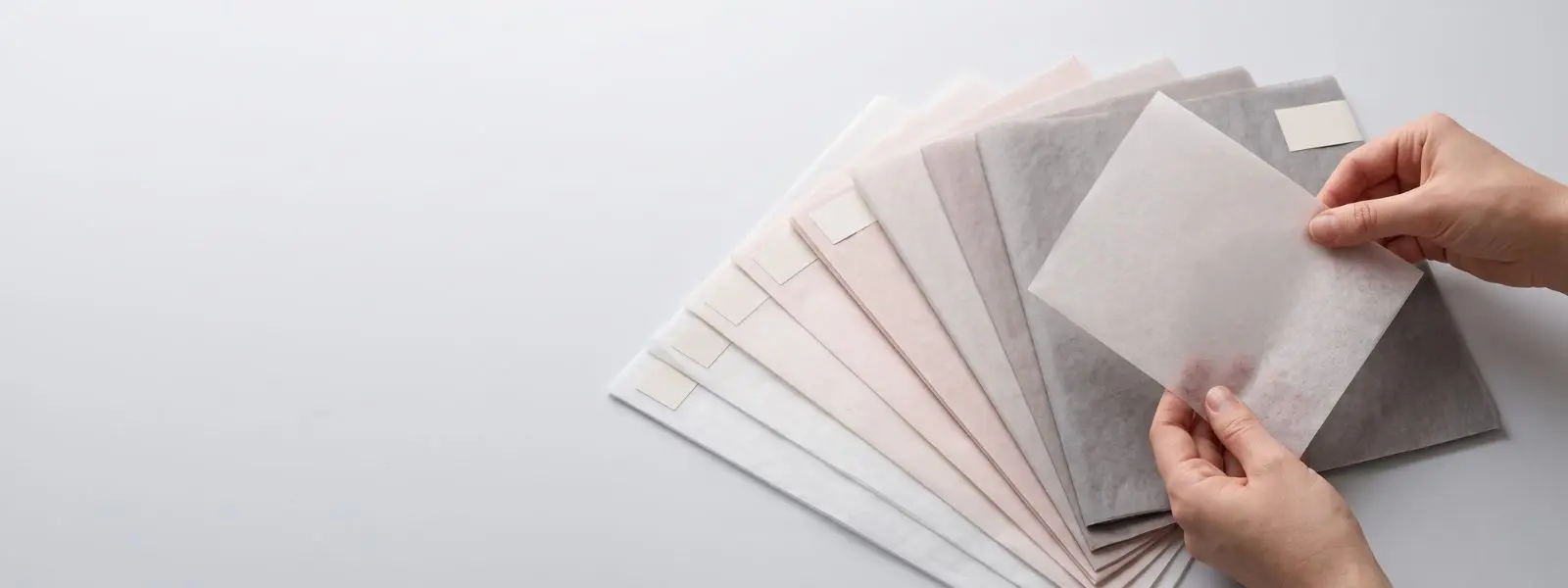
GSM is the single spec that decides how your tissue paper feels, prints, and protects — yet it is the one most businesses guess at. Order too light and a heavy product tears through it or the print shows through; order too heavy and you overpay for bulk a delicate item never needed. Getting the weight right is what makes tissue feel intentional rather than incidental.
Tissue paper for packaging typically runs from 17 to 40 GSM. Choose 17 GSM for delicate, luxury wrapping, 22–28 GSM as a versatile standard with better opacity and print, and 30–40 GSM for protecting heavier items or a premium, substantial feel. Heavier is not automatically better — the right weight depends on the job.
GSM (grams per square metre) measures the paper’s density: a higher number means a thicker, more opaque, more durable sheet, while a lower number means a thinner, more translucent, more flexible one. That single trade-off drives every choice below. This guide explains what GSM means for tissue, breaks down the common weights with their pound conversions, shows which GSM to pick by use case, and covers how weight affects printing and opacity. For the full product picture, see the custom tissue paper guide.
What Does GSM Mean for Tissue Paper?
GSM stands for grams per square metre and tells you how much one square metre of the tissue weighs, which directly reflects its thickness and density. It is the standard, supplier-neutral way to compare paper weight across countries and materials.
For tissue specifically, GSM governs three properties that matter in packaging: feel, opacity, and strength. A higher GSM produces a sheet that feels more substantial, blocks more show-through, and resists tearing better — useful for protection and premium presentation. A lower GSM produces a thinner, more translucent, more drapeable sheet that highlights print and folds easily — the classic luxury tissue look. Standard packaging tissue sits in a fairly narrow band, roughly 10 to 45 GSM, with most business use concentrated between 17 and 40. Knowing where your choice falls on that scale is the foundation of every other decision.
What Are the Common Tissue Paper GSM Weights?
Most custom tissue paper is offered in a handful of standard weights, each with a distinct feel and best use. The table pairs each with its approximate pound (lb) conversion, since some suppliers still quote weight that way.
| GSM | ≈ lb | Feel | Best for |
|---|---|---|---|
| 14–17 gsm | ~10–11 lb | Thin, soft, semi-translucent | Delicate wrapping, apparel, boutique, layering |
| 22 gsm | ~15 lb | Slightly stronger, luxury texture | Better protection and print than 17 |
| 28 gsm | ~18 lb | Substantial, more opaque | Premium gift boxes, branded wrap |
| 30 gsm | ~20 lb | Thick, protective | Sturdier product protection |
| 35–40 gsm | ~24–27 lb | Heavy, opaque, upscale | Heavy items, cushioning, high-end presentation |
The pattern is consistent: as GSM rises, opacity, durability, and a premium hand-feel increase, while translucency and drape decrease. The most popular single weight is 17 GSM — thin, soft, cost-effective, and the recognisable “tissue” look — with 22–28 GSM stepping up for brands that want more presence and print clarity. Weights of 35 GSM and above move into genuine protective and luxury territory.
Which Tissue Paper GSM Should You Choose?
Choose your tissue GSM by matching weight to the product and the impression you want — delicate and elegant, versatile and branded, or protective and premium. The table turns common scenarios into a fast pick.
| Your use case | Recommended GSM | Why |
|---|---|---|
| Luxury apparel, clothing, scarves | 17 gsm | Soft, elegant drape and fold |
| Boutique / delicate small items | 17 gsm | Lightweight, premium boutique feel |
| Everyday branded product wrap | 22–28 gsm | Versatile balance of feel and print |
| Premium gift boxes | 28 gsm | Added opacity and a substantial feel |
| Heavier or structured products | 35 gsm | Durability and protective support |
| Electronics, home goods, cushioning | 35–40 gsm | Robust protection in transit |
| Layered branding across a box | 17 or 28 gsm | Easy layering, cohesive presentation |
A useful principle: pick the lightest weight that still protects the product and holds your print cleanly. A luxury clothing brand often prefers 17 GSM precisely because its softness reads as refined, whereas a heavier product line needs 35 GSM to feel and perform right. When two products in the same order differ a lot in weight or fragility, running two GSM weights is often smarter than forcing one to cover both.
How Does GSM Affect Printing and Opacity?
GSM affects printing and opacity directly: heavier tissue is more opaque and gives a sturdier print surface, while lighter tissue is more translucent and can show print through the sheet. Both looks are valid — the choice is deliberate, not a quality ranking.
On opacity, a low-GSM sheet like 17 GSM is semi-translucent, so a bold print, or the colour of the product beneath, can show through — often desirable for a soft, layered aesthetic, but worth planning around for crisp logos. Stepping up to 22–28 GSM increases opacity and print clarity, which is why brands wanting a sharp, contained logo often choose it. On print feel, heavier GSM generally provides a slightly sturdier print experience, while many brands still prefer the lighter weight for that classic luxury-tissue drape. Two nuances competitors rarely mention: thicker is not automatically better — the best GSM is the one that fits the use, not the highest number — and colour affects perceived substance, so a dark 17 GSM tissue (black, for example) can look denser and more premium than its weight suggests, though light-coloured or metallic inks read best on dark stock. Decide the look first, then let GSM and colour serve it.
For weights, colours, and print methods, explore custom tissue paper and printed tissue paper.