
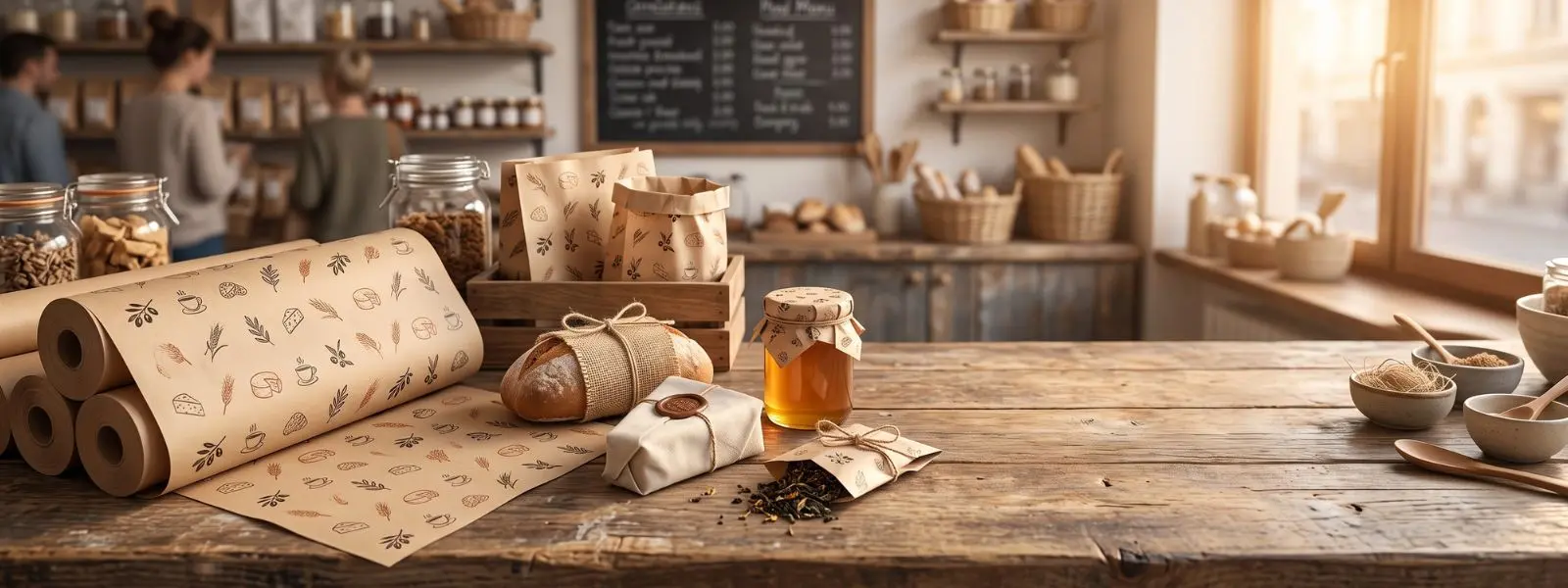
For years, custom paper felt like something only big brands could afford — order thousands of units or don’t bother. That barrier is largely gone. Thanks to digital printing, a small café, bakery, or food truck can now put its logo on branded wraps, bags, and sheets in small runs, without committing to a warehouse full of stock. If minimum order quantities have kept you on plain paper, this is the explainer that shows how low-MOQ options actually work — and how to start small.
The short version: MOQ (minimum order quantity) exists for real economic reasons, but modern digital printing has pushed those minimums low enough that branding your business no longer requires being big. Here is what MOQ is, why it exists, what today’s minimums look like, and how a small business should approach it.
What is MOQ, and why does it exist?
MOQ, or minimum order quantity, is the smallest number of units a supplier will produce in a single custom run. It exists because every custom order carries fixed costs that do not change with quantity — and those costs have to be covered somehow.
Think about what happens before the first sheet prints: there is a printing setup, often a plate or die charge, color matching, and machine makeready. Those costs are the same whether you order 100 sheets or 10,000, so on a tiny order they dominate and make each unit expensive. There is also an efficiency factor — very small batches do not suit fully automated production, and frequent switching between jobs lowers a factory’s throughput. A minimum order quantity is how suppliers keep the per-unit price reasonable and the run worth setting up. Understanding this is the key to low MOQ: anything that reduces those fixed setup costs is what makes small runs possible.
How low-MOQ custom paper became possible
Low and no-minimum custom paper exists today largely because of digital printing, which eliminates the plates and heavy setup that forced big minimums in the first place. It is the single development that opened custom paper to small businesses.
Traditional methods like flexographic and gravure printing require plates (one per color) and significant makeready, so they only become economical over large runs — which is why they carry high minimums. Digital printing skips the plates entirely, printing straight from a file, so there is little fixed cost to spread and a run of a few hundred (or even a single sample) stays affordable per unit. It still delivers full-color CMYK printing, so a small order does not mean a lower-quality logo. The trade-off is that digital’s per-unit price stays relatively flat as volume grows, so it wins for small runs while flexo takes over for bulk — the full comparison is in digital vs flexo vs offset printing. For a small business, digital is the reason “custom” and “small quantity” can finally go together.
What are typical MOQs for custom paper?
Minimums vary widely by product and print method, from single samples up to several thousand — so the right MOQ depends on what you order and how. The table gives a realistic sense of the landscape.
| Order type | Typical minimum | Notes |
|---|---|---|
| Samples / prototypes | 1 – a few | Often no minimum, to test design |
| Digital short run | ~100–500 | Affordable small runs, full color |
| Standard custom run | ~500 | Common “sweet spot” for value + full options |
| Bulk / flexo run | ~1,000s+ | Lowest per-unit, needs volume |
A commonly cited sweet spot is around 500 units: it is small enough to be accessible to a growing business, yet large enough that the setup cost spreads to a reasonable per-unit price and you keep full freedom over size, material, and finishing. Below that, some suppliers offer digital short runs or samples with fewer options, and above it, bulk runs unlock the lowest per-sheet cost. These are industry-typical ranges, not fixed rules — always confirm the actual minimum with your supplier for the specific product.
The trade-off: low MOQ vs unit cost
Low MOQ is not free — the trade-off is a higher price per unit, in exchange for lower total cost, less risk, and more flexibility. For most small businesses, that is a trade worth making early on.
Because fixed setup costs spread across fewer units, a small run always costs more per sheet than a bulk order. But the total outlay is far smaller, you are not sinking cash into inventory that may sit in storage, and you keep the freedom to change your design, test a new SKU, or run a seasonal batch without overcommitting. In other words, you pay a premium per unit to avoid a much larger risk. As your volume and certainty grow, moving up to larger, bulk runs lowers the per-unit cost — the natural progression for a scaling business. For how those unit costs actually break down, see how much custom food paper costs.
How a small business should approach it
Start small, prove the design, then scale — using low MOQ to reduce risk while you learn what works. This is the practical path from plain paper to a fully branded, cost-efficient program.
Begin with a sample or a short digital run to confirm your logo, colors, and paper look right in real use before committing to more. Brand your highest-visibility item first — usually the wrap, bag, or sheet every customer sees — rather than everything at once. Keep the design simple and consistent, since a saved, unchanging design avoids repeat setup costs on reorders and keeps your brand cohesive. Use standard sizes and stock to stay in the low-MOQ, low-cost lane. Then, as demand becomes steady and predictable, graduate to larger bulk runs to bring your per-unit cost down. This “start small, scale up” approach lets a small business look established from day one without carrying big-brand risk — and whether a given item is worth branding at all is covered in custom vs generic packaging.
Why low MOQ is a small-business advantage
Used well, low MOQ is not a compromise — it is a genuine advantage for a small or new business. It lets you order only what you need, keeping cash free and shelves clear of overstock. It lets you test and iterate, trying designs and SKUs and responding to real customer feedback instead of guessing at scale. It lets you look established, sending samples and serving customers in branded packaging that signals maturity beyond your size. And it lets you move seasonally, running holiday or limited-edition batches without long-term commitment. For a business finding its feet, that flexibility is worth more than the lowest possible unit price. Explore small-run-friendly options in custom food paper and request a sample before you scale.