
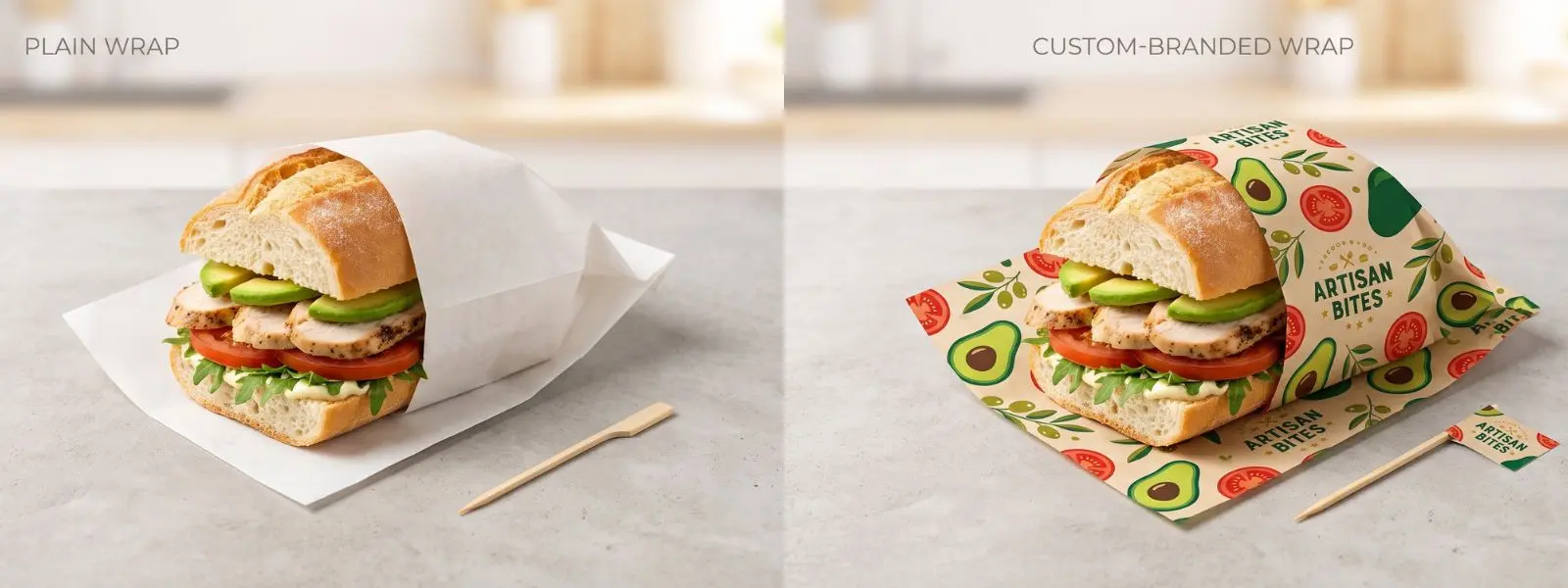
Every business hits this decision: pay a little more for packaging with your name on it, or save the money and use plain stock. It is usually framed as custom versus generic — but that framing hides the real question. The right question is not “custom or generic?” It is “does a customer see this piece, and how much is that impression worth?” Answer that honestly, item by item, and the decision makes itself.
This is a straight, even-handed look at whether branded paper packaging is worth it. There is a strong case for custom — and there are genuine situations where generic is the smarter call. This guide covers both, gives you a simple framework to decide for your own business, and lays out the MOQ and cost math so you can run the numbers instead of guessing.
What “custom” and “generic” actually mean
Generic packaging is standard, off-the-shelf, unbranded stock — plain white or kraft bags, wraps, cups, and sheets that are cheap, widely available, and functional. Custom packaging is the same items printed with your logo, brand colors, and design. The physical product can be identical; the difference is whether it carries your brand or stays anonymous.
That difference sounds cosmetic, but it changes what the packaging does. Generic packaging performs a job — it carries and protects. Custom packaging performs that same job and adds a second one: every time it is seen, on a table, a doorstep, a desk, or in a photo, it is a brand impression. Whether that second job is worth paying for is the entire debate.
The case for custom paper packaging
Custom paper packaging is worth it wherever a customer sees or touches it, because it converts a functional item into repeated, compounding brand exposure. For food and retail businesses especially, paper packaging is the touchpoint that reaches 100% of customers on every single order.
The returns show up across several lines. Perceived value rises — customers associate packaging quality with product quality, which supports higher prices and lower price-sensitivity. Recognition compounds — consistent logo and colors across bags, wraps, and cups make a business memorable and build brand equity with every order. Retention improves — a considered package makes customers more likely to return. And reach expands — branded packaging is what gets photographed and shared, earning exposure no ad budget bought. Studies commonly find that upgrading from generic to well-designed custom packaging delivers meaningful sales lifts, often in the 10–20% range for small businesses, which is why the break-even is usually tiny relative to the upside. Generic packaging, by contrast, does the physical job and nothing else — it builds no recognition, tells no story, and is invisible in the unboxing era.
When generic is actually the right call
In the interest of honesty, custom is not always worth it — there are clear cases where generic packaging is the smarter, more responsible choice. Branding something no customer will ever notice is just spending money.
Generic makes sense when:
- The item is back-of-house — freezer paper, prep liners, and storage sheets no customer sees do not need branding.
- You are testing a product or new to market — before you know a product will sell, plain stock keeps risk and cash outlay low.
- Volume is very low — at tiny quantities, custom’s per-unit premium is hardest to justify.
- Margins are razor-thin on a commodity item — if a piece adds no perceived value and the customer does not register it, keep it generic.
The mistake is treating this as all-or-nothing. The goal is not to brand everything, but to brand the pieces that earn it and leave the rest generic.
The decision framework: is it worth it for you?
Decide item by item using five questions, because the answer differs for a takeout bag versus a storage liner. Run each piece of packaging through this checklist:
| Question | Points toward custom if… |
|---|---|
| Does a customer see or touch it? | Yes — it’s a brand impression |
| Is there repeat-purchase potential? | Yes — recognition compounds |
| Is your niche competitive? | Yes — packaging is the tiebreaker |
| Does the volume clear the MOQ affordably? | Yes — per-unit premium is small |
| Is there margin or pricing room? | Yes — perceived value pays for it |
The more “yes” answers a piece collects, the more clearly custom is worth it. A branded takeout bag or coffee cup will score high — customer-facing, high-frequency, competitive, high-volume. A back-of-house prep sheet will score low. This is exactly why the honest answer is “it depends on the item,” and why a good packaging program mixes both.
The MOQ and cost math
Custom paper packaging carries a slightly higher per-unit cost at very low quantities, but that gap narrows sharply with volume, and setup is usually a one-time cost. Many suppliers now offer low minimum order quantities, so you no longer have to be a large brand to print your own — you can start branding the customer-facing pieces early.
Run the real math rather than reacting to the sticker price. Against a small per-unit premium, weigh the upside: higher perceived value that supports pricing, repeat purchases, fewer returns from better presentation and protection, and free reach from shares. Because paper packaging is inexpensive and touches every order, the break-even is often a fraction of a percent of additional sales — a small lift in loyalty or price acceptance typically covers the cost several times over. The businesses that build brand equity early tend to outrun the ones that wait until they feel they can “afford” it.
The middle path most businesses should take
For most food and retail businesses, the answer is not custom or generic — it is custom where it counts and generic where it does not. Brand the high-visibility, high-frequency, customer-facing pieces first — the bags, wraps, cups, tissue, and napkins a customer actually sees — and keep plain stock for back-of-house items no one notices. This phased, prioritized approach captures the brand value where it exists without overspending where it does not.
That is the same logic behind building a coherent packaging system rather than a pile of one-off items — see how to brand your food business with paper packaging for the full playbook, and how custom tissue increases sales for the revenue mechanics. To price your own pieces, explore custom food paper and custom paper bags and request a quote against your real volumes.