
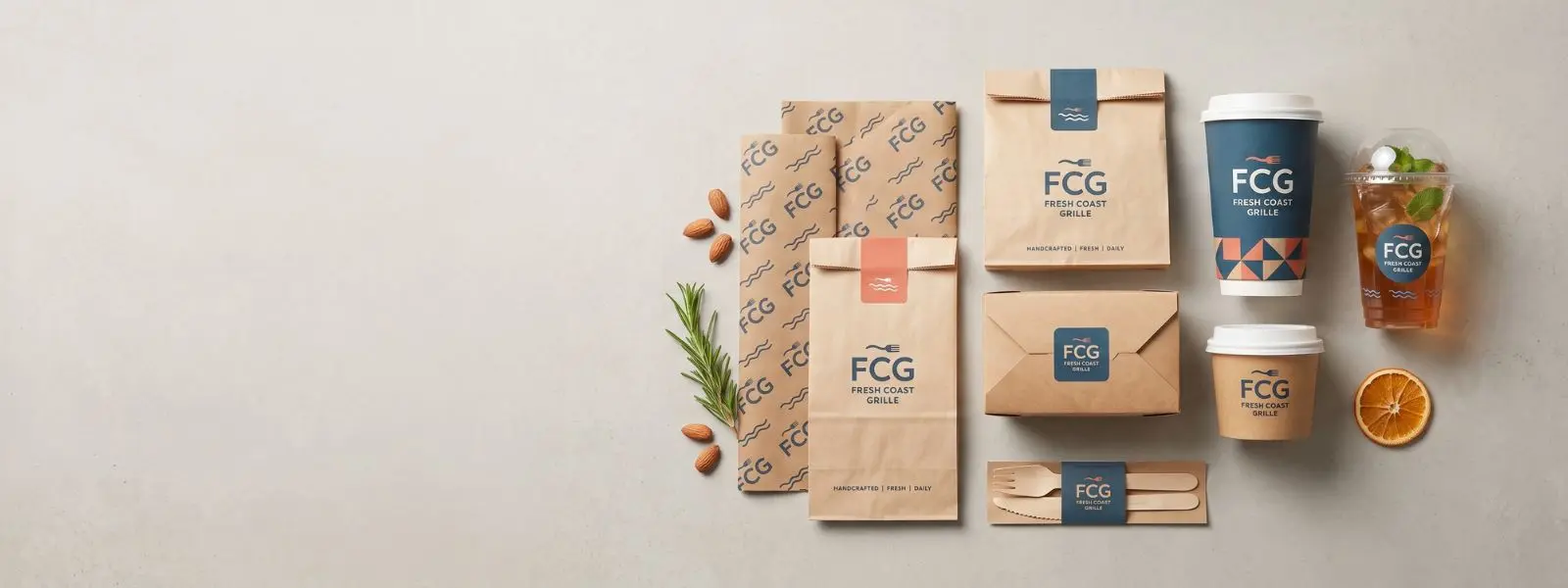
Your packaging is the one piece of marketing that reaches 100% of your customers. Not everyone sees your ad, opens your email, or follows your social account — but every single person who buys from you touches what their food comes in. For a food business, custom paper packaging is not a cost of doing business; it is the most reliable branding channel you own, working on every order without a media budget.
The mistake most food businesses make is branding one thing and forgetting the rest. A café pours specialty coffee into a beautiful branded cup, then hands it over in a plain, unmarked bag — and the moment is undone. The fix is a shift in thinking: stop buying packaging item by item and start designing a system where every paper touchpoint carries the same identity. This guide shows how to do exactly that, from the principle to the practical rollout.
Why packaging is your most powerful branding tool
Packaging is the customer’s first and most frequent physical contact with your brand, and it shapes perceived value before the food is even tasted. Material, print, and presentation all tell the customer how much to value what they are holding — a job a menu or a website simply cannot do at the moment of consumption.
It also compounds. Research on brand presentation suggests that staying consistent across every customer touchpoint can lift revenue by roughly a fifth, because repetition builds familiarity, and familiarity builds the trust that turns a first-time buyer into a regular. Every branded cup, bag, and wrapper is a small, repeated impression, and those impressions accumulate into recognition and preference. Add the way customers photograph and share their food, and a well-branded package quietly becomes free marketing that travels far beyond the person who bought it. Packaging is a silent salesperson that never takes a day off.
The principle: brand the system, not the item
The single most important idea in food packaging branding is consistency across the whole order, not standout on any one piece. A customer should recognize your brand from your cup, your bag, your napkin, and your wrap without hunting for the logo — because each one looks like it belongs to the same family.
This is where the mixed-message trap does its damage. Beautiful cups paired with generic bags, or a branded box lined with plain paper, send a signal of inconsistency that undercuts the care you put into the product. The remedy is to map every packaging touchpoint in a typical order and make sure each one carries the same colors, logo, and design language. When they all agree, the effect is cumulative: the brand feels considered, professional, and memorable. When they clash, even excellent food can feel like an afterthought.
Map your paper touchpoints
The practical starting point is to walk through a typical customer order and list every piece of paper involved — that list is your branding surface. It looks different for each kind of food business, so find yours below.
- Cafés and coffee shops — branded paper cups are the flagship touchpoint, extended by sleeves, napkins, and retail coffee bags for beans sold to take home.
- Dine-in restaurants — the tabletop is your canvas: custom napkins, placemats, food liners, and branded takeout paper bags for anything that leaves.
- Takeout and quick-service — greaseproof wraps and liners, food-grade paper, paper carry bags, napkins, and cups carry the brand out the door.
- Bakeries — bakery bags, parchment and pan liners, greaseproof sheets, and tissue wrap for boxed goods.
- Food retail and DTC — custom tissue, wrapping paper, kraft paper and bags, and labels turn a shipped order into a branded unboxing.
Once you can see every touchpoint written down, the gaps are obvious — the plain bag, the unbranded liner, the generic cup — and those gaps are exactly where your brand is currently leaking.
Build a simple brand system first
Before ordering anything, define a small, repeatable design system, because you cannot apply a brand consistently that you have not pinned down. The good news is it takes only a few decisions.
Fix five things: your logo, two or three brand colors, one or two typefaces, a single overall look (natural kraft versus clean white is the usual fork), and the tone of any copy. Then apply them identically to every touchpoint. Choose your material look deliberately — kraft signals natural, artisan, and eco, while white signals clean, modern, and premium — and keep it consistent so the brand reads the same across cups, bags, and wraps. Favor restraint: a single well-placed logo repeated across every piece looks more professional than a different busy design on each. Two small additions pay off out of proportion to their effort — put your website or social handle on the packaging to turn a one-off purchase into a searchable, repeat customer, and design with the customer’s phone camera in mind, since clean, on-brand packaging is what gets shared.
Where to start: prioritize by visibility and volume
You do not have to brand everything at once — start with the highest-visibility, highest-volume touchpoint and expand from there. Spending your first budget where the most eyes land gives the fastest return.
Rank your touchpoints by two factors: how many customers touch each one, and how visible it is during and after the sale. For a café, that is almost always the cup; for a takeout spot, the carry bag and the wrap; for a bakery, the bag and the tissue. Brand those first, then work down the list as budget allows, always keeping new pieces consistent with what came before. Because paper packaging is inexpensive per unit and reaches every customer, the return on even a phased rollout is strong — a branded cup or bag often earns more brand exposure than an equivalent spend on advertising, and it keeps working on every order indefinitely. Order coordinated pieces together where you can, so colors and print match across the set.
Make sustainability part of the brand story
In 2026, sustainable packaging is an expectation rather than a bonus, and for a food brand it is also a branding opportunity — provided you can prove it. Customers increasingly read a business by what it wraps food in and what happens to that wrapping afterward.
Choose recycled or responsibly sourced kraft, food-safe and PFAS-free papers, and recyclable or compostable options where they fit your operation, then let those materials carry the message. Natural, unbleached stock reinforces an artisan, eco identity at a glance, while a printed line about recyclability or responsible sourcing makes the commitment explicit. The key is substance over slogan: back claims with real materials and certifications rather than vague “eco” language, because customers — and increasingly regulators — reward proof and penalize greenwashing. Done honestly, sustainability becomes part of why customers choose and remember you.
Bringing it together
Branding a food business with paper packaging comes down to four moves: define a simple brand system, map every paper touchpoint, prioritize the highest-visibility pieces, and order them coordinated so the whole order tells one story. Approve a proof on each piece so colors and logo stay consistent across the set, and revisit the map as you add menu items or channels. The payoff is a brand that shows up in every customer’s hands, feels effortless and cohesive, and turns ordinary packaging into the most dependable marketing you run.
Start by exploring the pieces most food businesses build around — food-grade paper, paper bags, paper cups, napkins, and tissue — and request a proof so every touchpoint matches before your run.