
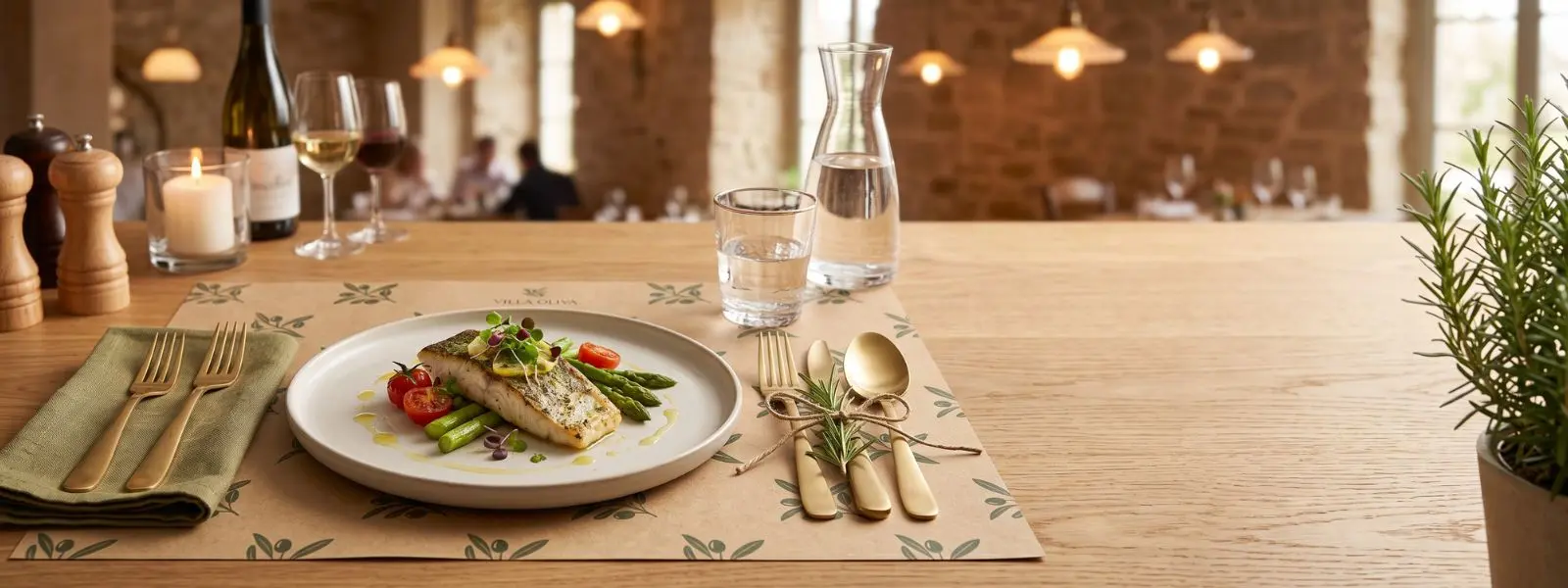
A guest waits, on average, around twenty minutes for their meal — and most of that time is spent looking down at the table. That is twenty minutes of undivided attention on a surface most restaurants leave blank or generic. A custom placemat turns that idle time into the single largest branded canvas at the table, working as a menu, a promotion, an activity for kids, and a mini-billboard all at once.
This guide is built in two parts. Part one covers design — what to actually put on a placemat so it earns its place. Part two covers buying — the paper, sizes, and printing choices that make it look right and last through a meal. Get both halves right and a placemat becomes one of the highest-return, lowest-cost marketing pieces a restaurant runs.
Part 1 — Design: What to Put on a Restaurant Placemat
The placemat’s advantage is real estate and attention. Unlike a napkin’s small surface or a menu that gets closed, the placemat sits open in front of the guest for the whole meal. The design challenge is deciding which jobs to give it without crowding the plate off the page.
The jobs a placemat can do
A single placemat can carry several messages at once, and the best designs pick a few rather than all of them:
- Branding — your logo, name, and look, quietly reinforcing identity for the length of the meal.
- Menu and specials — the dish of the month, a new item, or a seasonal feature placed where every guest will read it.
- Promotions — a loyalty offer, a QR code to your online ordering or reviews, an event, or a next-visit incentive.
- Kids’ activities — a maze, coloring art, or a word game that keeps children occupied and parents relaxed.
- Local advertising — space sold or shared with nearby businesses.
That last point is worth its own note. The ad-supported placemat is a classic diner model: you share the design space with a few local companies, which offsets — or even covers — your printing cost while giving those businesses visibility. It turns a marketing expense into a break-even or revenue line.
Designing it so it works
Because a plate and glass will cover the center, keep essential branding and messages toward the edges and corners where they stay visible. Favor clarity over clutter: a placemat trying to say everything says nothing, so lead with one primary message and let the rest support it. Keep it unmistakably on-brand — the same logo, colors, and type as your signage and menu — and coordinate it with your other tabletop pieces, so it reads as one identity alongside your custom napkins. If children are a real part of your crowd, design the activity zone deliberately and remember the paper has to take a crayon, which leads directly into the buying decisions below.
Part 2 — Buying: Paper, Size, and Printing
Once the design is settled, a few practical choices determine how the placemat feels and performs. None are complicated, but each affects cost and the final impression.
Paper stock
Most restaurant placemats are printed on uncoated offset paper in the 60–70 lb range, and that is uncoated for a reason: it absorbs minor spills, feels classic rather than slick, and — critically — takes pen and crayon, which a glossy coated stock resists. For everyday, high-volume service, uncoated 60–70 lb is the sensible default. Lighter economy stocks (around 40–50 lb) cut cost for one-time or promotional runs, while a heavier premium uncoated board suits upscale rooms that want a substantial, near-reusable feel. If you specifically want vivid photography of dishes to pop, a coated or matte stock reproduces images more sharply — but you trade away writability, so it is the wrong pick for a kids’ placemat.
Size
Placemats run from about 10″ × 14″ up to 18″ × 12″, and the right one is set by your table and place setting. The 10″ × 14″ size is the classic diner and kids format; 14″ × 11″ and 17″ × 11″ suit standard adult settings; and larger formats around 14″ × 20″ give a more spacious, upscale presentation. Square options exist for square or round tables. Choose a size that frames the place setting with a little margin around the plate — large enough to protect the table and hold the design, not so large it overwhelms the setting.
Printing and sides
Full-color (CMYK) printing handles logos, photos, and colorful kids’ art, while one- to four-color spot printing is a clean, economical route for simpler, brand-color designs. One practical constraint: standard placemat stock is thin, so it is usually printed on one side only — two-sided printing generally requires a thicker stock and a custom quote. For most restaurants, a strong single-sided design is all a placemat needs. Reference size table below.
| Size | Best for |
|---|---|
| 10″ × 14″ | Diner, kids, cocktail tables |
| 14″ × 11″ | Standard adult place setting |
| 17″ × 11″ | Wider settings, more content |
| 14″ × 20″ | Large tables, upscale presentation |
| 14″ × 14″ | Square or round tables |
Ordering
Placemats order easily: minimums are low (often as few as 25) and scale to very large runs, with fast turnaround that makes them practical for seasonal menus and one-off events. Lock the design first, choose stock and size against your tables, supply print-ready artwork with the required bleed, and approve a proof. Because menus and specials change, many restaurants print in shorter, more frequent runs so the placemat always reflects the current offer.
Explore custom placemats, including diner placemats, and coordinate them with custom napkins and the wider custom paper for restaurants range. Request a proof before your run.