
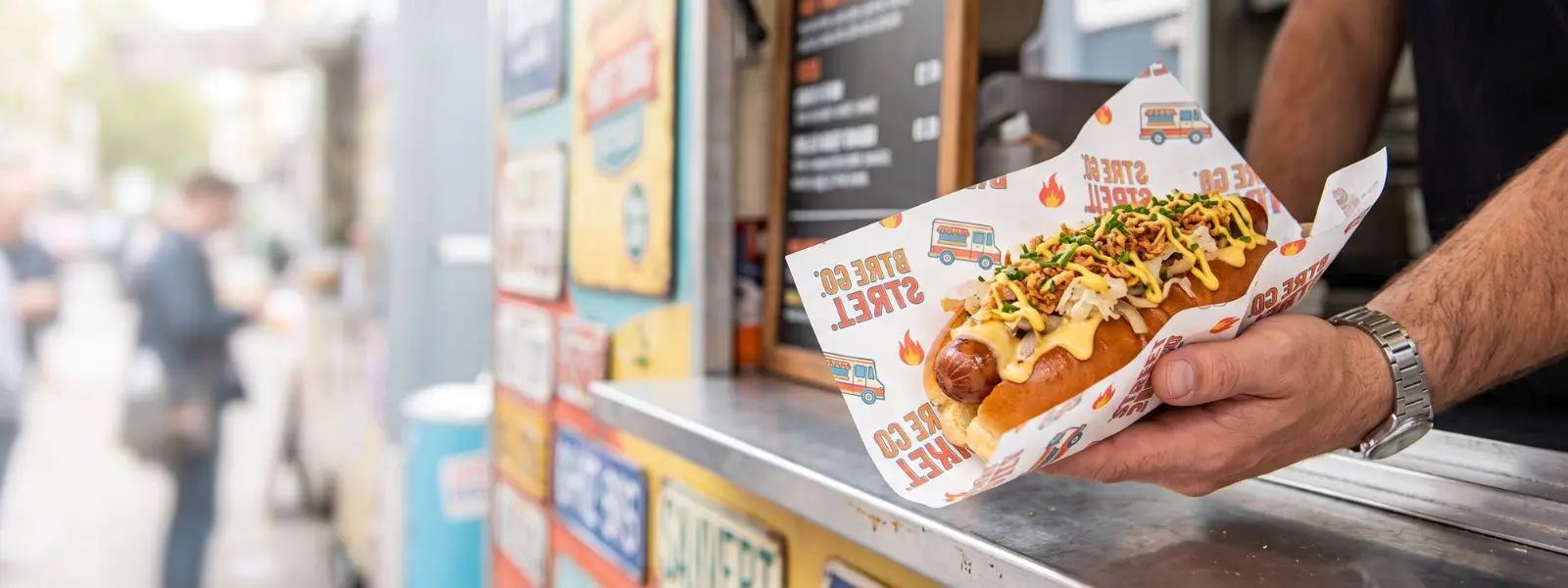
A hot dog is one of the messiest things a food business hands over — hot, greasy, loaded with condiments, and eaten on the move. The wrapper around it does real work: it keeps the dog warm, stops grease and chili from reaching the customer’s hands, keeps the bun from going soggy, and — done right — puts your brand in front of everyone at the game, the fair, or the food truck line. Choosing the right wrapper is part food science, part branding. This guide covers both.
The two decisions that matter most are the format (wrapper, sleeve, or bag) and the material (foil-lined or greaseproof paper). Get those right for your style of hot dog and everything else falls into place. Here is how to choose, size, brand, and order custom hot dog wrappers.
Wrapper, sleeve, or bag: which format?
Hot dog packaging comes in three paper formats, and the right one depends on how loaded your dogs are and how they are served. Each solves a slightly different problem.
| Format | What it is | Best for |
|---|---|---|
| Wrapper | A flat grease-proof sheet folded around the dog | Simpler or smaller dogs, or dogs in a bag |
| Sleeve (jacket) | An open-ended paper or foil pocket | Loaded, topping-heavy dogs; on-the-go eating |
| Foil-lined bag | A foil-lined paper pouch | Takeout and delivery, maximum heat retention |
A wrapper is the classic fold-around sheet — quick, cheap, and ideal for a plain or smaller dog. A sleeve is a sturdier pocket that supports a fully loaded “gladiator” dog without it sliding out or falling apart, which is why toppings-heavy concepts favor it. A foil-lined bag is the choice when the dog has to travel and stay hot, sealing in heat for takeout and delivery. Many operations stock two — a simple wrapper for the standard dog and a sleeve for the loaded specials.
Foil-lined vs greaseproof paper: which do you need?
This is the central decision: greaseproof paper for quick, simpler service and foil-lined for loaded dogs that need heat retention and leak protection. Each has a clear trade-off.
Greaseproof paper — coated with food-safe wax or an aqueous barrier — resists grease, moisture, and heat, so a fresh dog does not soak, stick, or tear its wrapper. It is lighter, more economical, prints crisply, and, with an aqueous coating, can be microwave-safe for quick reheating. Foil-lined paper (a foil interior with a printable paper exterior) does something greaseproof cannot: it retains heat and forms a barrier that stops condiment liquid — chili, sauerkraut, mustard, relish — from seeping into the bun, so the sausage stays juicy and the bun stays intact through transport. The trade-offs are that foil costs a little more and is not microwave-safe.
| Factor | Greaseproof paper | Foil-lined paper |
|---|---|---|
| Heat retention | Moderate | High (insulating) |
| Condiment leak barrier | Good | Excellent |
| Microwave-safe | Yes (aqueous coated) | No |
| Cost | Lower | Higher |
| Best for | Quick-serve, simpler dogs | Loaded dogs, takeout, delivery |
One nuance worth knowing: the enemy of a good hot dog wrapper is steam. A fresh dog releases steam, and a cheap, uncoated wrapper traps it and turns soggy. A quality greaseproof sheet manages that moisture, while foil retains heat but holds more moisture in — so match the material to whether warmth or a crisp bun matters more. For the barrier itself, see greaseproof paper.
What size hot dog wrappers do you need?
Size the wrapper to your bun — standard, jumbo, or footlong — so the dog is fully covered without excess paper. Most standard hot dog buns run about 5.5 to 6.5 inches, and standard wrappers and sleeves are built to fit them.
If you serve jumbo or footlong dogs, you will need a custom size so the dog does not slide out of a too-short sleeve or leave a loaded dog exposed. As a rule, the wrapper should cover the full length of the bun with enough material to fold or hold securely, plus a little room for toppings. Sleeves typically include a gusset so they open into a pocket that supports the dog. When ordering custom, give your supplier the exact bun length and whether the dogs are loaded, and they can size the wrapper or sleeve to fit — the simplest way to avoid a wrapper that is too tight or a sleeve that lets the dog escape.
How to brand and print hot dog wrappers
Print your brand on the outside of the wrapper only, in food-safe inks, turning every hot dog into a mobile advertisement. Because the inside touches food and grease, printing is kept to the exterior to stay food-safe and practical.
The exterior paper surface takes a logo, tagline, brand colors, full-surface pattern, QR code, or seasonal artwork cleanly. This is where hot dog packaging earns its keep as marketing: a branded wrapper carried through a stadium concourse, a fair, or a food truck line is seen by dozens of potential customers, functioning as advertising you are not paying media for. A few practical notes: keep the design bold and simple so it reads at a glance and prints cleanly on coated stock, use food-safe inks, and remember that metallic foil finishes should be avoided if customers might microwave the packaging. For design guidance on food paper, see designing your first custom food paper.
Food safety and sustainability
Every hot dog wrapper should be food-grade, and increasingly PFAS-free, since it is in direct contact with food. Confirm the paper is FDA-compliant for food contact with a non-stick, food-safe surface, and that any grease-resistant coating achieves its barrier without PFAS “forever chemicals,” per current regulation — the standard is covered in what is food grade paper.
On sustainability, unbleached kraft gives a natural, eco takeaway look and PE-free or aqueous coatings improve recyclability, so greaseproof kraft wrappers are the greener choice. Foil-lined packaging retains heat best but is harder to recycle, so it is a trade-off between performance and end-of-life — reserve foil for the loaded dogs and delivery orders that genuinely need it, and use recyclable greaseproof for the rest. To order, confirm your format, material, size, branding, and food-safety compliance, then approve a proof. Explore options in custom food paper and request a sample before your run.