
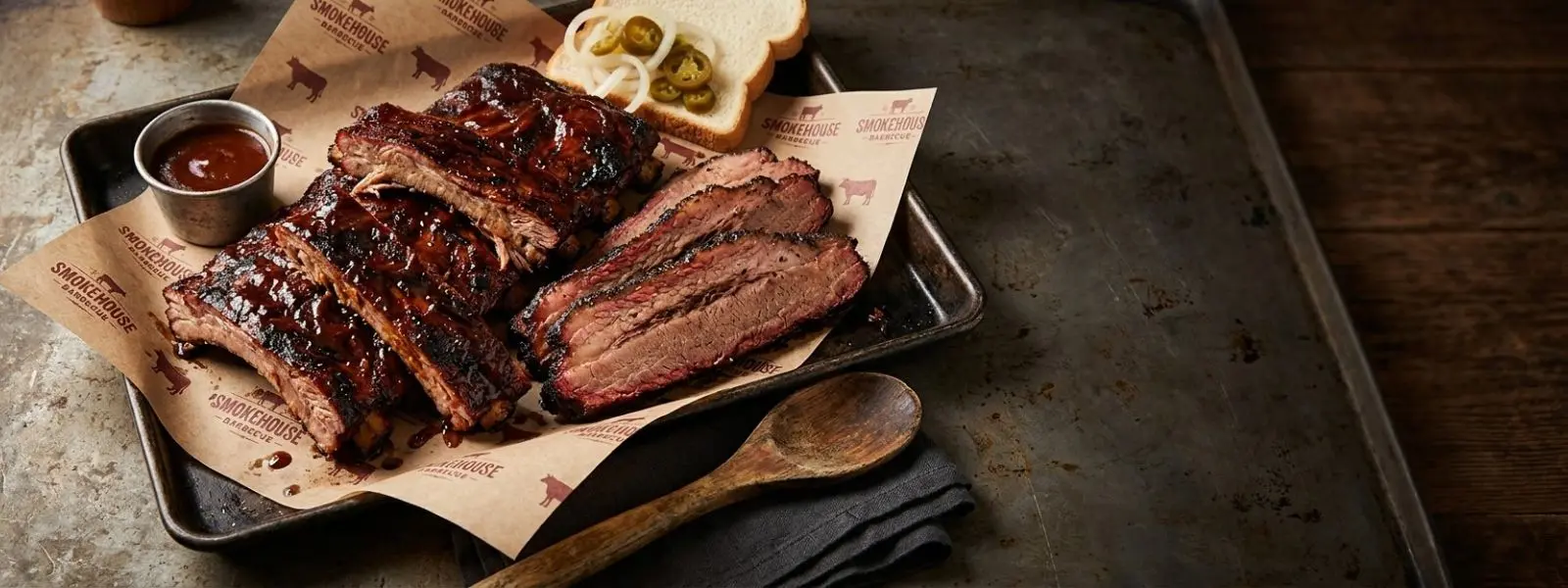
Every branded burger wrapper and logo-printed deli sheet is the latest chapter in a very old story. Long before a café could print its name on a sheet of greaseproof, people faced the same simple problem: how do you carry food without losing, crushing, or spoiling it? The answer evolved over two thousand years — from leaves to parchment to kraft to the printed wrap in a customer’s hand today. It is a history of solving grease, strength, and freshness, one invention at a time, until packaging stopped being merely functional and became part of the brand.
This is the story of how food wrapping paper got from the butcher’s counter to the modern brand — and why the humble sheet around your lunch carries more history than it lets on.
Before paper: leaves, cloth, and the first wrappers
The earliest food wrapping used whatever nature provided. Across the ancient world, large leaves, husks, and woven materials wrapped and carried food — a practice that survives today in banana-leaf and corn-husk cooking. These first wrappers did the essential jobs: they contained portions, kept hands clean, and offered a little protection. What they lacked was consistency, and any resistance to grease or moisture. Food wrapping would not truly advance until a flexible, mass-producible material arrived — and that material was paper.
Paper arrives: China and the first paper wrapping
Paper was invented in China, where the official Cai Lun is traditionally credited with refining and standardizing papermaking around the early second century. Almost as soon as paper existed, it was used for more than writing: early records describe paper being used to wrap and pad goods, including foods, making China’s papermakers arguably the first to wrap food in paper. For centuries the technique stayed largely within Asia, spreading slowly westward along trade routes. When papermaking finally reached Europe and industrialized, the raw material for modern food wrapping was in place — but one big problem remained unsolved: ordinary paper is useless against grease.
The 19th century: greaseproof, parchment, and the science of resistance
The breakthrough that made paper genuinely useful for food came in the 1800s, when chemistry was applied to the sheet itself. In the mid-nineteenth century, papermakers developed vegetable parchment by treating paper with sulfuric acid — a process, sometimes called parchmentizing, that gels the fibers into a dense, grease- and water-resistant sheet. For the first time, paper could hold butter, fat, and moisture without soaking through. Around the same period, greaseproof paper was produced by heavily refining the pulp so the fibers packed tightly enough to resist oil.
Wax paper answered the same problem from a different direction: coating paper in paraffin created a moisture barrier ideal for wrapping candy, baked goods, and perishables, and it became a common household and commercial wrap by the later nineteenth century. Together, these innovations solved the ancient grease problem and gave shopkeepers papers fit for real food. The lineage runs straight to today’s products — see what is greaseproof paper and what is parchment paper.
Strength from wood: the kraft revolution
If the mid-1800s solved grease, the late 1800s solved strength. The kraft process — developed by the chemist Carl F. Dahl in Germany around 1879 — produced paper from wood pulp that was dramatically stronger than what came before. The name says it plainly: kraft is German for “strength.” This strong, inexpensive brown paper was perfect for wrapping heavy and awkward goods, and it quickly became the backbone of food and retail packaging.
The same era industrialized the paper package itself. Inventors like Margaret Knight, whose machine produced the flat-bottomed paper bag in the 1870s, turned wrapping into a manufactured product rather than a hand-folded craft. Butcher paper — sturdy kraft for wrapping cuts of meat — and the grocer’s brown bag became everyday infrastructure. For the material behind it, see what is kraft paper.
The butcher shop era: paper as everyday infrastructure
By the early twentieth century, paper wrapping was simply how food moved. The butcher wrapped meat in kraft, the deli folded cold cuts into waxed or greaseproof sheets, the baker bagged bread, and the grocer tallied an order into a brown paper sack. This was the golden age of the plain wrap: functional, cheap, and everywhere, but almost entirely unbranded. The paper’s job was to protect and carry, and it did so anonymously. A customer might recognize the shop by its awning, but never by its wrapping. That was about to change — because the same paper that protected food turned out to be a perfect surface for a message.
From plain to printed: the branding age
The middle of the twentieth century turned the wrapper into a billboard. As fast food and packaged retail scaled up, businesses realized the sheet already in every customer’s hands could carry a logo, a color, and a name. Printed burger wraps, branded deli sheets, and logo-covered bags spread through the food industry, and packaging quietly became marketing. A wrapper was no longer just protection; it was recognition, repeated on every order and carried out into the world. The great chains proved the point at scale — their packaging became as recognizable as their food — and smaller businesses followed, learning that a branded wrap made an operation look established and considered. Paper had completed its shift from anonymous utility to brand asset.
The modern era: sustainability, safety, and the custom brand
Today’s food wrapping paper carries two new demands that earlier eras never faced: prove it is safe, and prove it is responsible. For decades, grease resistance often relied on PFAS “forever chemicals,” but following regulatory phase-outs in 2024–25, modern food paper is expected to achieve its grease barrier without them and to meet food-grade standards for direct contact — the baseline explained in what is food grade paper. At the same time, sustainability has become an expectation, driving a return to recycled fiber, unbleached kraft, and plant-based coatings like soy wax — in a sense, a modern echo of the natural materials the whole story began with.
And branding has gone from a privilege of the giants to something any café, bakery, or food truck can access. Short print runs and low minimums mean a small business can now put its logo on the same greaseproof sheet the corner butcher once used blank. The wrapper has come full circle: still solving grease, strength, and freshness, but now doing it safely, sustainably, and with a brand printed on top — the subject of branding a food business with paper packaging.
A short timeline
- ~2nd century — Papermaking refined in China; paper used to wrap and pad goods.
- Mid-1800s — Vegetable parchment and greaseproof paper solve the grease problem.
- Late 1800s — The kraft process brings strength; wax paper and machine-made bags industrialize packaging.
- Early 1900s — Plain kraft and waxed papers become everyday food-shop infrastructure.
- Mid-1900s — Printed, branded wraps turn packaging into marketing.
- 2020s — PFAS-free, sustainable, and custom-branded food paper define the modern sheet.